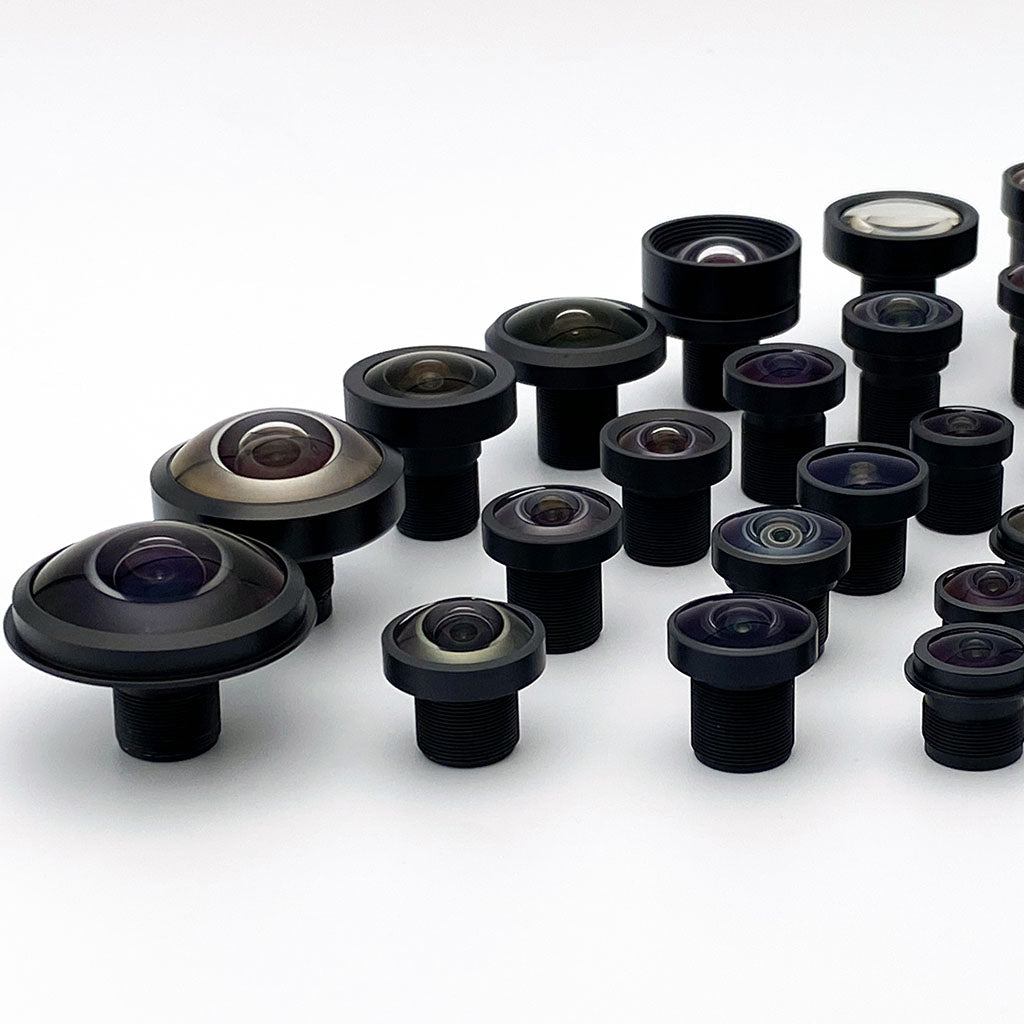

M12 Fisheye Lenses for 180° and Wider Fields of View
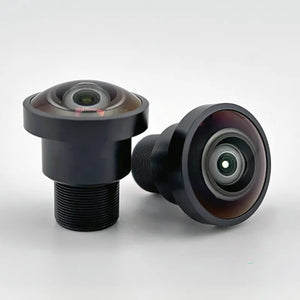
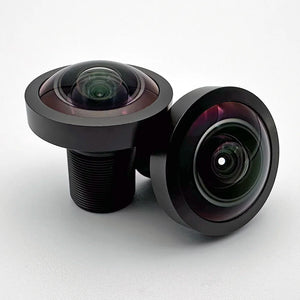
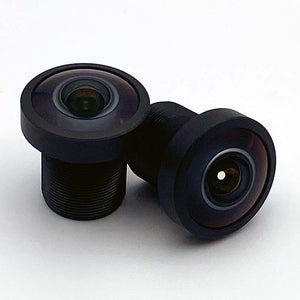
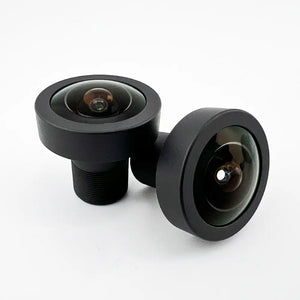
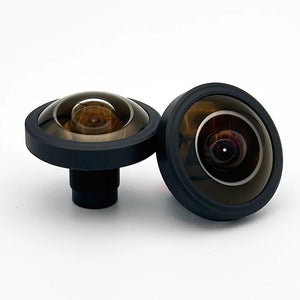
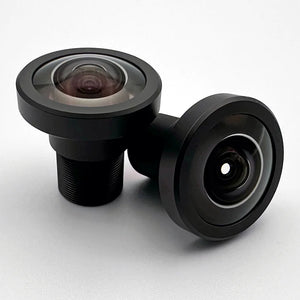
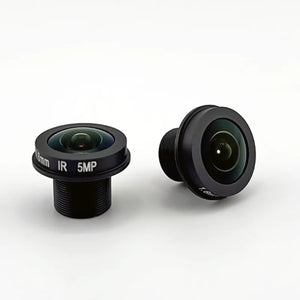
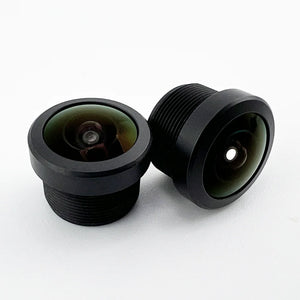
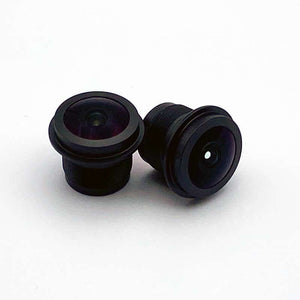
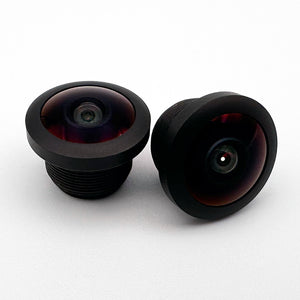
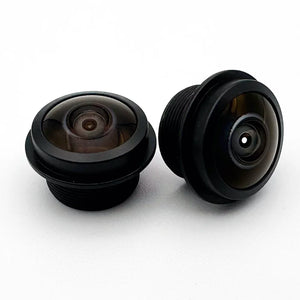
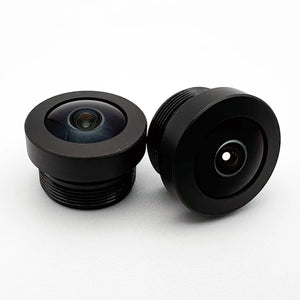
These ultra-wide S-mount fisheye camera lenses cover published fields of view from 180° to 226° in this collection, with image circles from 2.9mm to 9.3mm. Datasheets with projection and distortion curves are on each product page.
A fisheye lens is a camera lens built around a non-rectilinear projection, typically covering 180° or more. Commonlands stocks 19 M12 fisheye designs for embedded vision, robotics, and security cameras, including stereographic, f-theta, IP67, and IR-corrected models. For the projection math, read the wide angle vs fisheye lens guide, or browse the full M12 lens catalog.
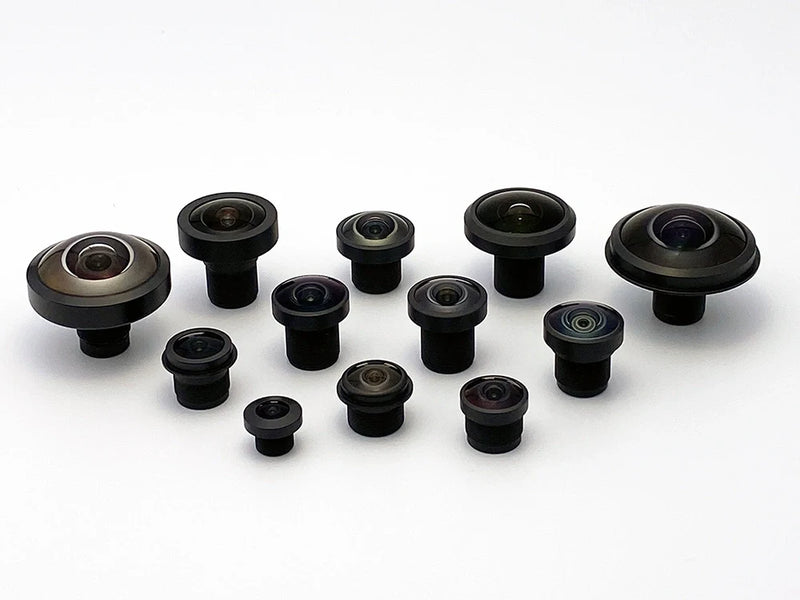
All M12 Fisheye Camera Lenses
Titles state the published maximum field of view at the full image circle: 200°@2.9mm means 200° on a sensor whose active diagonal fills the 2.9mm image circle. The widest design here reaches 226°; the CIL213, at 230°, is the widest M12 fisheye in the Commonlands catalog and is not part of this collection. Sold-out designs are hidden; contact engineering for restock dates.
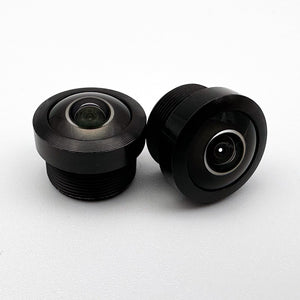
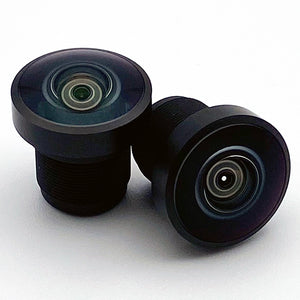
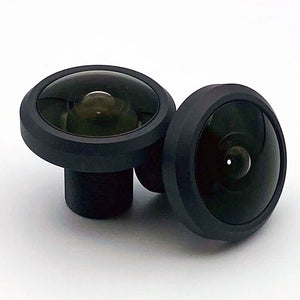
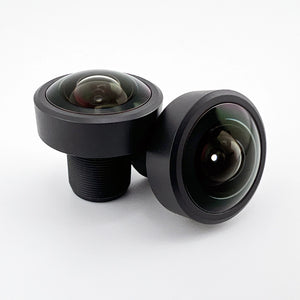
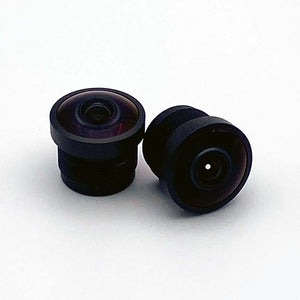
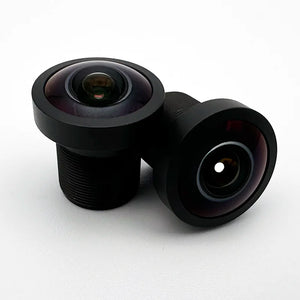
Why Do Fisheye Lenses Curve Straight Lines?
A fisheye lens curves straight lines because its projection maps ray angle to image height differently than a rectilinear lens does. Rectilinear designs correct barrel distortion to keep lines straight, which caps how wide they can go. Fisheye designs drop that constraint on purpose. The curvature you see, often called the fisheye effect, is the projection working as designed, not a defect that slipped past quality control.
Barrel (negative) distortion also buys coverage: measured against the rectilinear reference, a strongly negative mapping packs more field angle into the same image height, which is how fisheye designs keep 180° and beyond finite on the sensor. It does not rank lenses for you. Coverage depends on the projection, the image circle, and how each vendor defines EFL and quotes distortion, so one distortion percentage at one field point cannot order two lenses by field of view. Compare published maximum field at a stated image circle instead.

Which Fisheye Projections Does Commonlands Stock?
Projection choice decides how the lens distributes resolution across the field, so it belongs in the requirements list next to field of view and image circle.
| Projection | What It Preserves | Common Use | Stocked Examples |
|---|---|---|---|
| Stereographic | Local shapes and angles | Object recognition, viewing | CIL207, 220°@4.0mm · CIL293, 190°@5.4mm |
| F-theta (equidistant) | Constant radial scale, r = f·θ | SLAM, angular measurement | CIL292, 182°@7.1mm |
| Other fisheye designs | Projection stated per datasheet | Surround view, security cameras | CIL208, 200°@2.9mm · CIL220, 215°@6.8mm |
The remaining designs state their projection on the product datasheet, so you can match the calibration model before buying. Projection formulas, their inverses, and the orthographic special case are in the wide angle vs fisheye guide; f-theta scanning optics get their own treatment in what is an f-theta lens.
How Much Field of View Do You Actually Get?
Less than the headline number, unless your sensor fills the image circle. Put a fisheye on a sensor smaller than its image circle and it becomes a cropped fisheye: only the central region of the projection lands on the sensor, diagonal coverage narrows, and the apparent curvature drops. The same lens that covers 215° at its full image circle can act like a wide angle lens on a smaller sensor.

Sensor format names like 1/2.7" do not convert cleanly to millimeter dimensions, so match the lens image circle against the sensor’s active-area diagonal from the image sensor reference, not the format fraction. Then compute coverage for the exact lens and sensor pair with the FOV calculator, which accounts for distortion. The rectilinear formula r = f·tan(θ) does not apply to fisheye projections.
What Does Fisheye Distortion Do to Computer Vision?
Fisheye lens distortion changes object scale across the field, which deforms features. A CNN detector trained on rectilinear imagery loses accuracy behind a fisheye it never saw in training, and classic line detectors assume straight edges the projection will not provide. You have two options: undistort frames before inference, at the cost of extra computation and a possible crop of the field, or train directly on the native projection. Which wins depends on the pipeline, so validate on your own data.

For calibration, OpenCV’s cv2.fisheye module implements the Kannala-Brandt model: an odd polynomial in ray angle whose coefficients you solve from your own images. It has no named-projection setting. Fitted well it can describe equidistant, equisolid, and stereographic lenses alike, so knowing the nominal projection tells you what the fitted curve should look like, not which mode to select. Judge a fit by the reprojection residuals you measure across the field angles the application actually uses. The step-by-step workflow lives in the guide linked above, and Commonlands supplies per-lens distortion data on request to support it.
Where M12 Fisheye Camera Lenses Get Used
One fisheye camera covers what would otherwise take two or three conventional cameras. Overhead fisheye security cameras watch a full room from the ceiling through a single 180° or wider lens; the IP67-sealed CIL222 (188°@6.6mm) handles exterior housings. Focal length picks by camera type are in lenses for surveillance.
Mobile robots and drones use fisheye navigation cameras for SLAM and obstacle detection, where wide coverage shrinks feature-tracking dead zones during rotation. Platform picks are in lenses for robotics and lenses for drones. For day-night cameras under near-infrared illumination, the IR-corrected CIL239 (186°@5.2mm) holds focus where standard designs shift.

Frequently Asked Questions About Fisheye Lenses
당사 광학 엔지니어링 팀의 기술적 답변
What is a fisheye lens?
A fisheye lens is a camera lens built around a non-rectilinear projection. Warren Smith’s Modern Optical Engineering sets the field of view at 180° or more, though cropped-circle designs can cover less and remain fisheye. Instead of keeping straight lines straight, the projection maps ray angle to image height in a way that keeps coverage past 180° finite on the sensor. M12 fisheye lenses package that projection in a compact S-mount barrel for board cameras.
What does a fisheye lens do?
It renders straight lines as curves that bow outward from center, with curvature growing toward the edges. That fisheye effect is the projection’s designed geometry, not a defect. Local magnification falls with distance from the optical axis, so edge objects look smaller than a rectilinear lens would render them. The payoff is coverage: a single fisheye camera lens can watch a full hemisphere.
What is a fisheye lens used for?
Applications where one camera must cover a whole scene: overhead security cameras, automotive surround view, robot and drone navigation, and SLAM. Equidistant designs also handle angular measurement. When geometry has to read straight off the sensor without calibration, as in much metrology and lane detection, pick a rectilinear low distortion lens instead.
How do I calculate the field of view of a fisheye lens?
Start from the published figure in each product title, which states maximum field of view at the full image circle, such as 200°@2.9mm. If your sensor’s active diagonal is smaller than the image circle, coverage narrows. Use the FOV calculator, which accounts for distortion. The rectilinear formula r = f·tan(θ) does not apply to fisheye projections.
Can fisheye lens distortion be corrected in software?
Yes, within limits. Calibrate with OpenCV’s cv2.fisheye module, which fits the Kannala-Brandt polynomial in ray angle to your own images. It exposes no named-projection setting, but a good fit describes equidistant, equisolid, and stereographic lenses alike. Then undistort frames or work directly in ray space. Undistortion resamples the image and can crop the field, so many SLAM and surround-view pipelines consume the native projection instead. Commonlands provides per-lens distortion data to support either route.
Which projection should I pick, equidistant or stereographic?
Equidistant (f-theta) mapping holds the radial scale constant, r = f·θ, so equal field-angle steps map to equal radial steps. That suits SLAM, visual odometry, and angular measurement, though sampling is not uniform in two dimensions: tangential scale and solid angle per pixel still change with field angle. Stereographic mapping preserves local shapes, which helps object recognition and human viewing. Commonlands stocks stereographic designs such as the 220°@4.0mm CIL207 and the f-theta CIL292. Each product datasheet states its projection, so you can match the calibration model before buying.
Do you stock sealed or IR-corrected fisheye lenses?
Yes. The CIL222 (188°@6.6mm) is IP67 rated for exterior housings, and the CIL239 (186°@5.2mm) is IR corrected to hold focus under near-infrared illumination. In-stock fisheye lenses ship the same business day from San Diego for orders placed before 12 PM PT, and lenses are MTF tested before shipping.
When should I use a wide angle lens instead of a fisheye?
When the algorithm reads geometry straight from pixel positions. Dimensional measurement, barcode reading, and off-the-shelf lane detection usually assume straight lines stay straight, so they favor a low distortion M12 lens. That is a pipeline constraint rather than a law: calibrated fisheye and ray-space methods handle lane detection and measurement too, so choose by the accuracy, camera model, and coverage your system needs. Fisheye wins when one camera must cover 180° or more, or when the pipeline already works from ray directions, as in SLAM and surround view.
Need Help Matching a Fisheye Lens to Your Sensor?
Send us your sensor part number and target coverage. US-based optical engineers will confirm image-circle fit and projection, then pull distortion data for your calibration. Orders placed before 12 PM PT ship the same day from San Diego.