

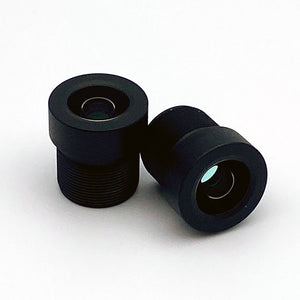
로봇에 사용할 M12 렌즈를 고르는 방법
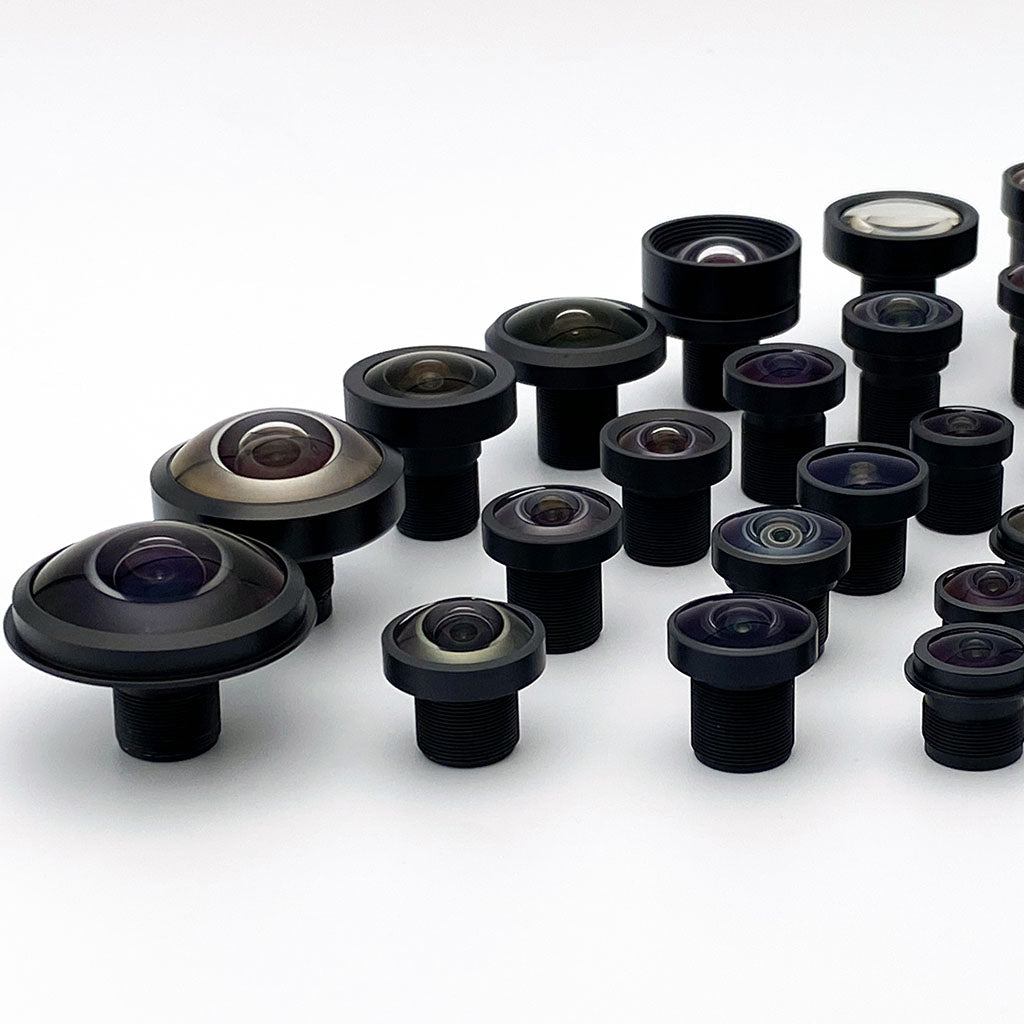
결국 시야각, 왜곡, 조리개 이 세 가지 요소가 핵심입니다. 이 세 가지 요소는 서로 상충 관계에 있으며, 적절한 균형은 로봇 카메라가 실제로 수행해야 할 작업에 따라 달라집니다.
시야: 커버리지 대 해상도
Wider FOV means more spatial coverage but less angular resolution per pixel. For obstacle avoidance, coverage wins: a 215° fisheye kills blind spots, though it introduces heavy barrel distortion. For SLAM feature tracking, a 6mm low-distortion lens gives you cleaner feature correspondence over a narrower view. A lot of production robots run both: fisheye for surround awareness, rectilinear for the primary nav direction.
당사의 시야각(FOV) 계산기를 사용하여 필요한 시야각을 계산하거나, EFL 계산기를 이용해 목표 각도를 기준으로 역산할 수 있습니다.
왜곡: 알고리즘이 처리할 수 있는 범위
Optical distortion reaches your vision pipeline through the camera model. ORB-SLAM, VINS-Mono, and similar systems work from a calibrated model, so what matters is how well that model fits your lens out to the corners, not whether the number clears a particular percentage. No universal threshold exists. Correction is cheaper than its reputation too: a precomputed remap runs fast on a Jetson, and fisheye-native front ends skip rectification altogether.
If you want the least distortion for the model to absorb, the CIL034 is the flattest lens in this set at roughly 0%, though its product page does not state which distortion metric that figure uses. The CIL023 is the wide option at 2.2mm and -5% TV distortion on a 4:3 frame.
장애물 감지 스택이 이미 어안 렌즈 모델을 지원하고 있다면(예를 들어 OpenCV의 어안 모듈), 190° 어안 렌즈는 왜곡이 있더라도 잘 작동할 수 있습니다. 소프트웨어가 이를 보정해 주므로, 렌즈는 가능한 한 가장 넓은 시야를 제공합니다.
조리개: 광량 확보 대 피사계 심도
Fast apertures let in more light, which matters in warehouses, parking garages, and dusk operation. The CIL327 (2.7mm, F/1.5) is the fastest lens in this set; at a standard field of view, the CIL059 (5.9mm, F/1.7) and the CIL061 (6mm, F/1.9) are the quick options. The catch: faster aperture means shallower depth of field. Objects at different distances won't all be sharp.
There is no single F-number that puts 30cm to infinity in focus. Hyperfocal distance falls out of focal length, F-number, and the circle of confusion you are willing to accept, and that last term follows your pixel pitch and how much edge blur the algorithm tolerates. A 2.7mm lens reaches a near hyperfocal at a much lower F-number than a 7.2mm lens does on the same sensor.
Run your own focal length, F-number, and sensor format through the DOF calculator, and treat the result as geometry rather than physics: stopping down buys less than the geometric depth suggests once diffraction takes over. We can send measured depth-of-field data for a given lens if the margin looks tight.
환경 보호
A warehouse AMR probably needs no rated lens at all. A delivery robot in Seattle needs the sealing somewhere, and you choose where. Rain-exposed builds usually evaluate IP67 lenses that seal at the barrel first; skipping a window and housing becomes an architecture option, taken only after validating the installed assembly. A standard lens sitting behind a window that the housing already qualifies carries no IP code of its own, and that is often the cheaper answer. If your robot gets pressure-washed, ask us about IP6K9K (industry shorthand IP69K) options.
Read any rating narrowly. It applies to the tested lens variant in its mounted configuration under the standard's water and dust exposures (IEC 60529 for IP67, ISO 20653 for IP6K9K, which are separate tests under separate standards). It does not cover steam, detergents, repeated sanitation cycles, UV exposure, condensation inside the barrel, or the rest of the camera.
센서 호환성
모든 M12 렌즈에는 이미지 서클이 있습니다. 이 이미지 서클이 센서의 대각선 길이보다 작으면 화면 모서리가 어두워지는 현상(비네팅)이 발생합니다. 일반적인 로봇 공학용 센서 규격:
- 1/4" (4.5mm diagonal) — the smallest common module format
- 1/3인치(대각선 6.0mm) — 로봇 공학 분야에서 가장 널리 사용되는 규격으로, 다양한 렌즈를 선택할 수 있습니다.
- 1/2.7" (6.7mm diagonal) — a common low-light robotics format
- 1/2인치(대각선 8.0mm) — 고해상도 용도
전체 치수는 당사의 CMOS 센서 크기 참조 자료에 나와 있습니다. 사용 중인 센서가 어떤 것인지 확실하지 않으시면, 데이터시트를 보내 주시면 적합한 제품을 추천해 드리겠습니다.