



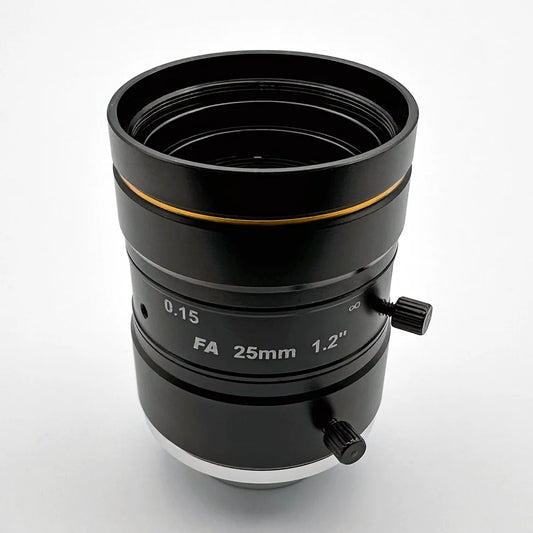
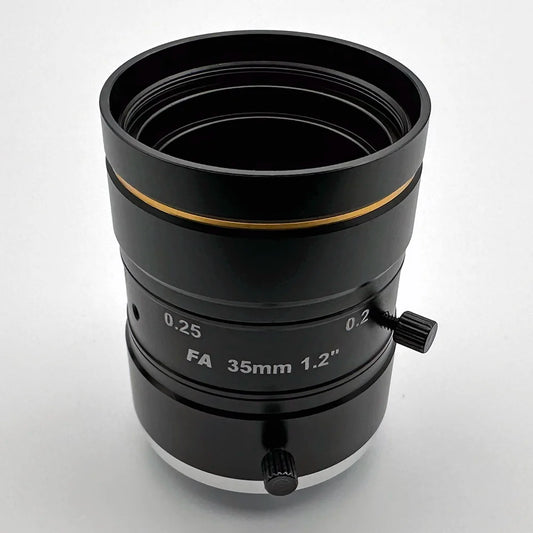
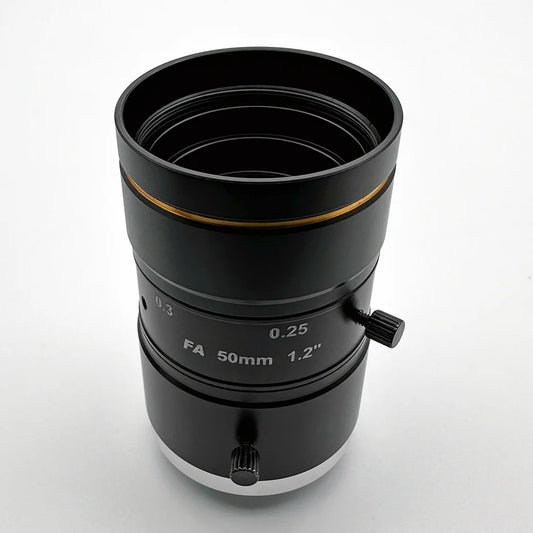
검사용 렌즈를 순서대로 지정하는 방법
모든 검사 렌즈 사양은 초점 거리나 센서가 아닌 결함에서 시작됩니다. 첫 단계의 결과는 단 하나의 수치, 즉 ‘최소 감지 가능 특징 크기’입니다. 도장 표면의 50마이크론 흠집과 가공 부품의 500마이크론 치수 편차는 후속 단계에서 완전히 다른 사양을 요구합니다. 결함 유형이 불분명할 경우, 가장 중요하게 여길 것으로 예상되는 가장 작은 특징을 기준으로 설계하십시오. 나중에 조리개를 넓히거나 배율을 낮출 수는 있지만, 애초에 포착되지 않은 세부 사항은 되살릴 수 없습니다.
필요한 해상도를 계산하십시오
Once you have a minimum feature size, work one example, not a fixed pixel rule. Say the station inspects a 100mm part for defects down to 50 micron, the defects are high-contrast against a uniform background, and the detector is a thresholding algorithm: budgeting 5 pixels per defect, 5 divided by 0.05mm gives 100 pixels per millimeter, so 10,000 pixels along the critical axis. The pixel count a given station actually needs depends on feature shape and contrast, system MTF, noise, and the detection algorithm, so validate the budget on real defect samples before freezing the sensor choice. Lens resolution must meet or exceed the sensor's pixel pitch. A 12MP sensor at 1.1" has 3.45 micron pixels; a lens rated for 12MP targets that sensor class, but the megapixel label is not proof of resolved pitch, so confirm against the lens's measured MTF data at your pixel pitch. Pairing a lower-rated lens with a higher-resolution sensor means the optical blur, not the sensor, sets your effective resolution.
작동 거리를 설정한 다음, 초점 거리를 계산합니다.
Working distance is set early by conveyor height, robot reach, enclosure dimensions, and part-loading clearance, not a free variable to pick after browsing a catalog. Once you have working distance and required field of view, focal length follows from the far-conjugate approximation, exact only in a pinhole ray model:
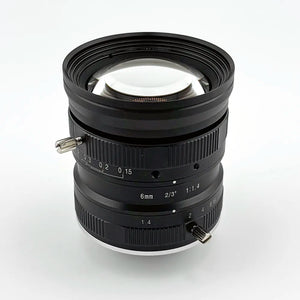
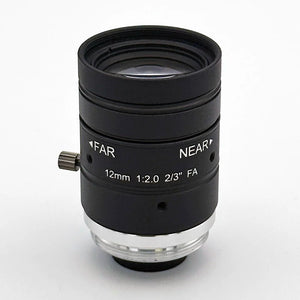
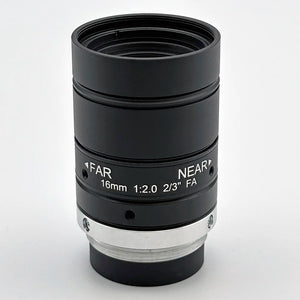
At a 300mm working distance, a required 100mm field of view, and a 14.1mm sensor width (1.1" sensor): the approximation gives EFL = 300 × 14.1 / 100 = 42.3mm, while exact thin-lens conjugates, with the working distance measured from the object-side principal plane, give roughly 37mm, so bracket both against stock focal lengths. On an adjustable C-mount lens, a ring sets focus; which internal elements that ring drives and how sharpness degrades at the near stop vary by design, so pull both from the datasheet or ask Commonlands engineering. M12 lenses focus by threading the entire barrel in and out of the holder. Treat working-distance tolerance and refocus behavior as properties of the specific lens and holder, not of the mount name. Verify your own numbers with the field of view calculator or the EFL calculator before ordering.
적절한 조리개 값을 선택하세요
For flat parts at a fixed working distance, open the aperture for maximum light throughput and resolution, typically F/2.8 to F/5.6 on C-mount industrial lenses, MTF permitting. For parts with height variation, stop down using the depth of field calculator. M12 lenses typically ship with a fixed aperture, which removes this lever entirely.
Two diffraction limits get quoted, and they mean different things. The tighter one is a detection threshold: at 550nm the Airy disk reaches two pixels wide near F# = 1.5 times the pixel pitch in microns, F/5.1 at 3.45 microns, F/4.1 at 2.74. Beyond it the lens under-resolves the sensor's own sampling grid. The looser one is the depth-of-field crossover near F# = 2 times the pitch, F/7 and F/5.5 for those same pixels, where added depth stops paying for the softening. Both move with wavelength and blur tolerance.
측정에서 왜곡은 합격/불합격 여부보다 더 중요합니다.
Distortion displacement is radial: it scales with a point's distance from the field center, not with total field width. At 0.5% distortion on a 100mm field, a point at the field edge can be displaced by roughly 0.25mm from its true position: noise against a plus or minus 1mm tolerance, a dominant error source against plus or minus 0.1mm. Print registration is the tightest case; seal-width and label-code geometry sit in the middle, where a sub-0.5% spec is usually sufficient; fill-level threshold checks are the most forgiving because the reference mark and meniscus sit in the same frame and a consistent error affects both similarly, as long as container presentation stays repeatable. For measurement-grade work the nominal distortion figure is only the starting point: traceable dimensional results also need a calibrated residual, controlled perspective, mechanical stability, and an error budget for edge localization. See the low distortion lens guide for the difference between TV distortion and rectilinear distortion conventions.
센서 포맷을 렌즈에 맞춰 주세요
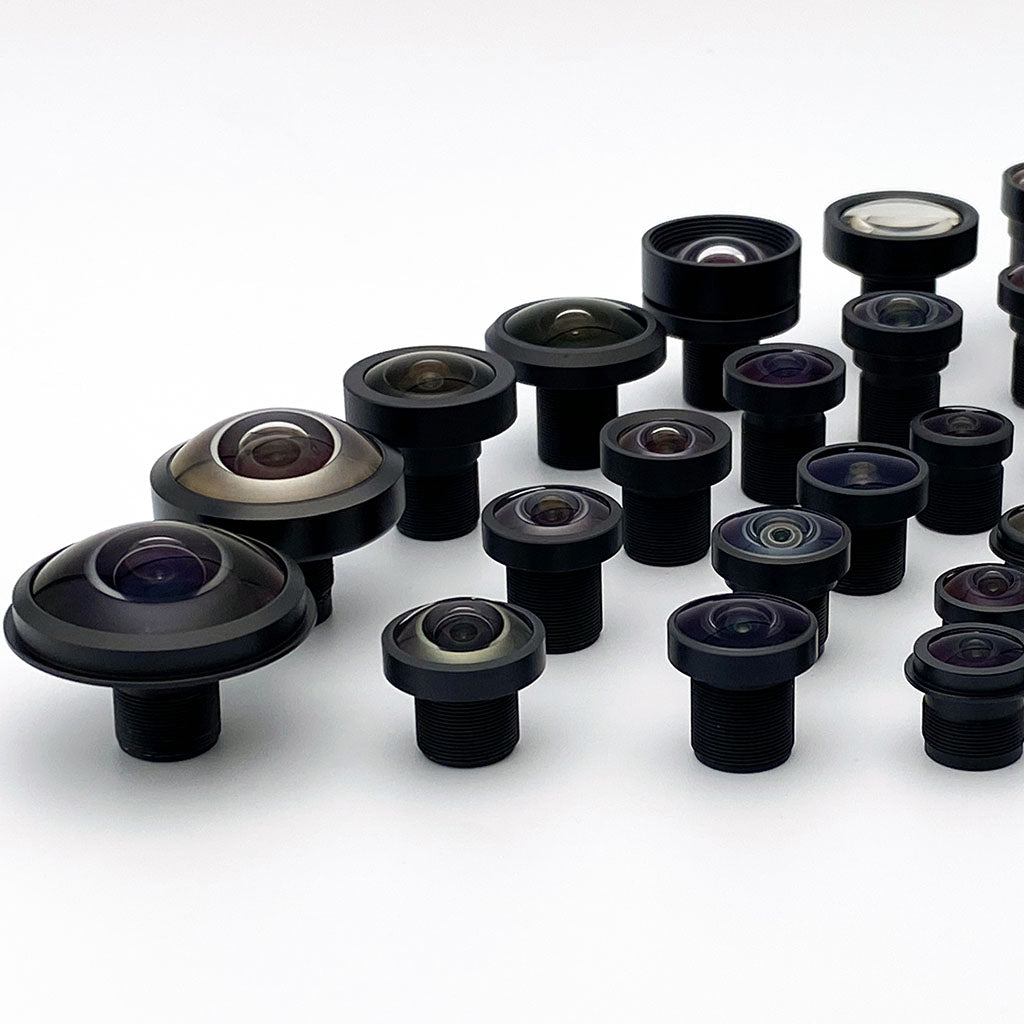
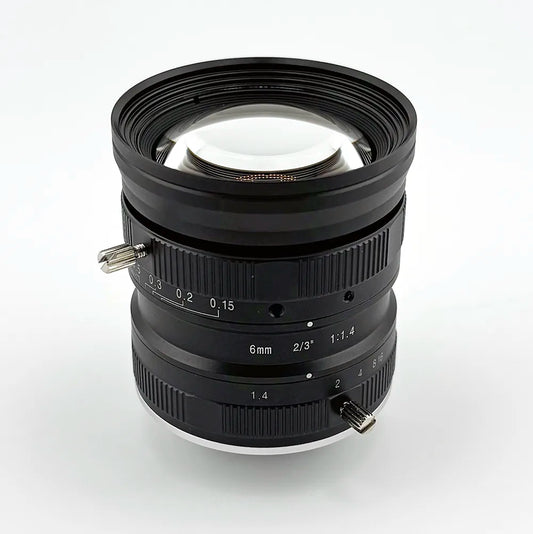
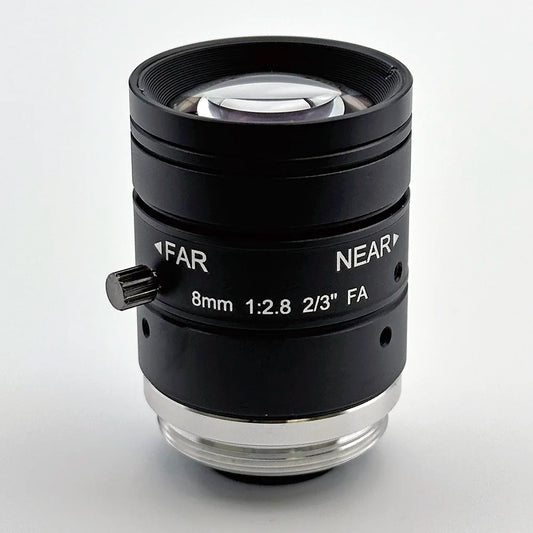
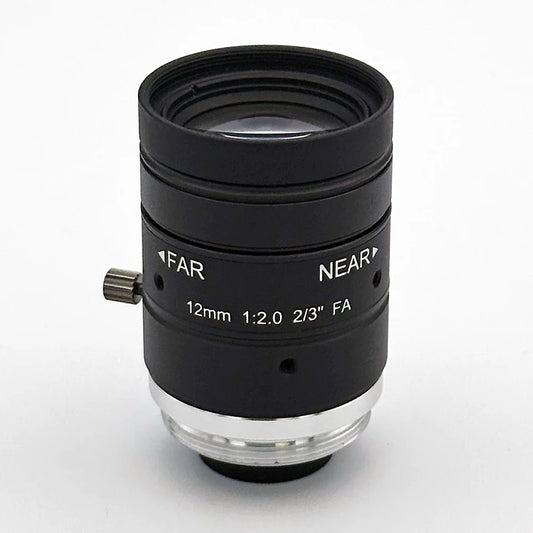
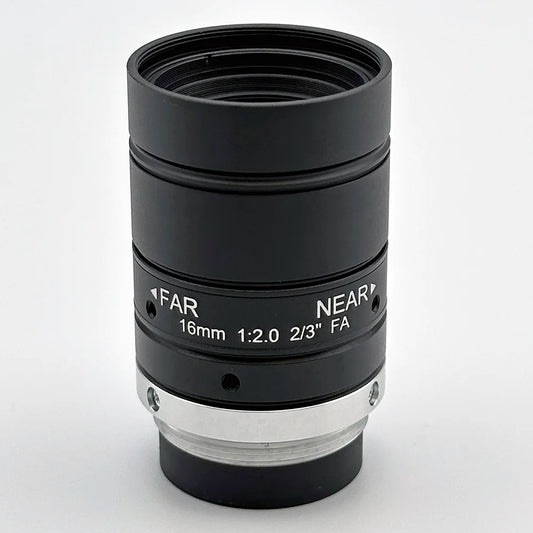
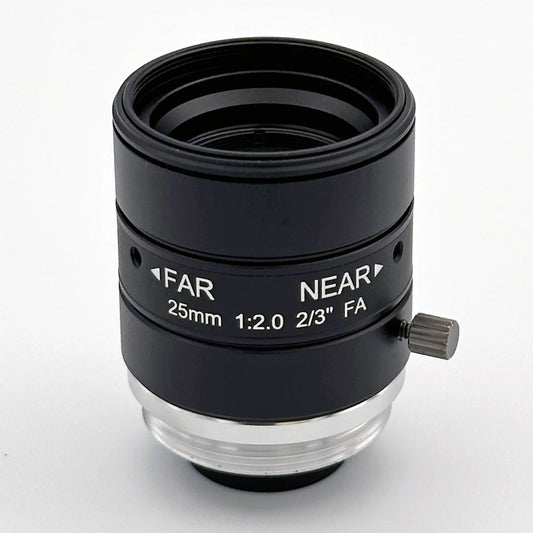
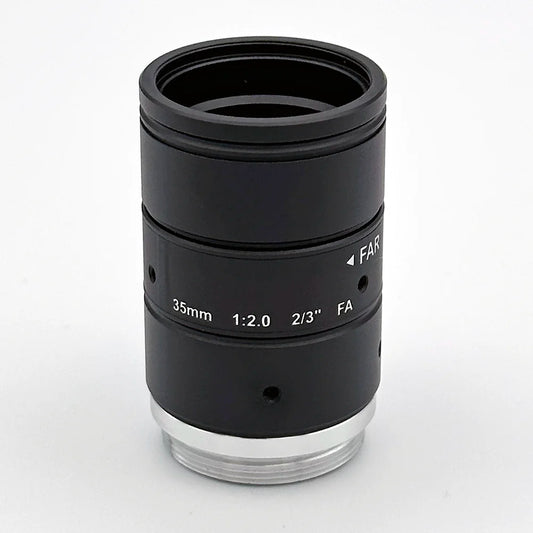
렌즈의 화각은 센서의 대각선을 완전히 덮어야 합니다. 2/3" 규격의 렌즈는 화각이 대략 11mm이며, 1.1" 센서의 대각선은 대략 17.6mm입니다. 1.1" 센서에 2/3" 렌즈를 장착하면 심각한 비네팅 현상이 발생합니다. 렌즈를 한 치수 더 크게 선택하는 것이 더 안전한 방법입니다. 렌즈가 너무 작으면 아무리 소프트웨어 보정을 해도 복구할 수 없는 비네팅이 발생합니다. 컴팩트한 M12 렌즈는 대개 동급 C-마운트 렌즈보다 가격이 훨씬 저렴합니다. 8레인 필 시스템의 경우, 19달러짜리 M12 렌즈와 119달러짜리 C-마운트 렌즈의 가격 차이는 스테이션 전체에서 약 800달러에 달합니다. 이러한 이점은 M12 렌즈의 화각이 센서를 여유 있게 커버할 때만 유효합니다. 자세한 규칙은 센서 크기 및 렌즈 호환성 가이드에서 확인할 수 있습니다.