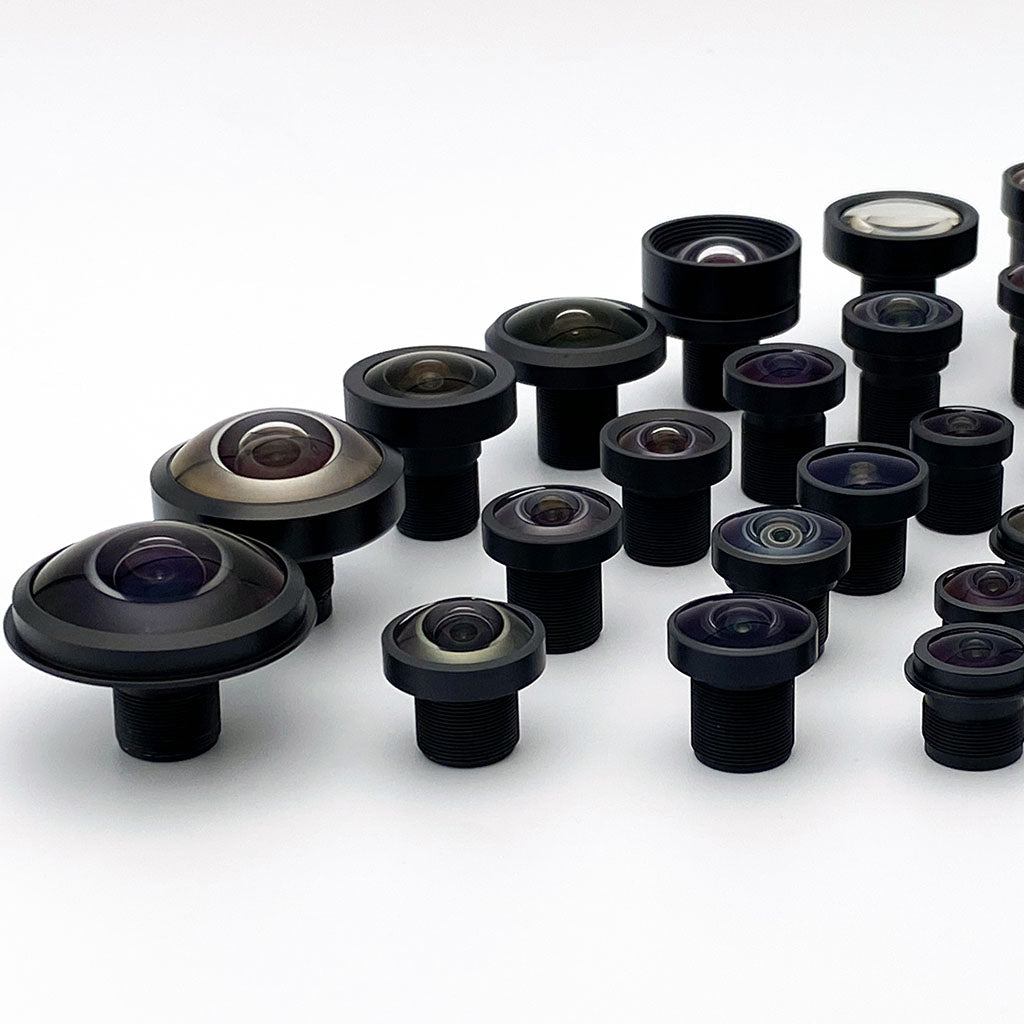

What Is a Low Distortion Lens? Barrel, Pincushion, and TV Distortion in Machine Vision
Barrel vs pincushion, TV vs optical distortion, what geometric correction actually fixes, and when a low distortion lens is enough versus when you need telecentric optics
A low distortion lens is a lens whose optical design minimizes geometric mapping error across the image field, so straight lines in the scene stay straight on the sensor. Distortion is signed and named by convention: barrel distortion (negative) bows lines outward, pincushion distortion (positive) bows them inward, though some datasheets publish only an unsigned magnitude. The number is also meaningless without knowing whether it is TV distortion or optical (radial) distortion, since the two metrics report different values for the same lens.
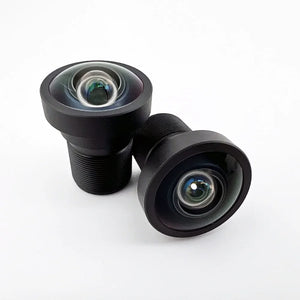
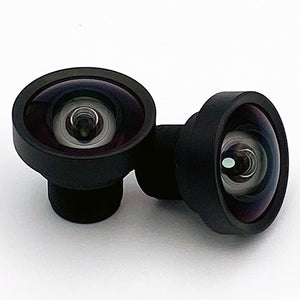
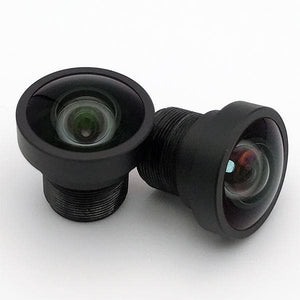
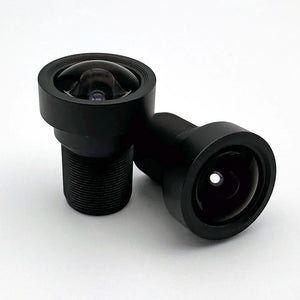
Commonlands low distortion M12 lenses include the CIL036 (−0.7% TV distortion), the CIL059 (−4% rectilinear distortion), and the CIL052 at −0.1% optical distortion for precision work; those figures use different metrics, so compare lenses within one convention. Low distortion is not telecentricity: it corrects where image points land at a fixed working distance, not whether magnification holds constant as object distance changes.
What a low distortion lens is
Every lens projects a three-dimensional scene onto a flat sensor. The ideal rectilinear projection maps straight lines in the scene to straight lines in the image, preserving angles and proportions at a given working distance. Real lenses deviate from this ideal. Barrel distortion pushes image points inward from where the rectilinear ideal would place them, making straight lines bow outward, away from the frame center. Pincushion distortion pulls points outward, making lines bow toward the axis. Both effects displace points near the edge of the image from their ideal positions.
A low distortion lens is one where this displacement has been reduced through optical design, often with aspherical surfaces or carefully balanced element groups that hold residual distortion to a small, specified percentage. Distortion is reported as a signed percentage of image height at a stated image circle: a negative value is barrel distortion, a positive value is pincushion. The CIL052 5.2mm M12 lens is specified at −0.1% rectilinear (optical) distortion at its 7.2mm reference image circle. The CIL535 35mm C-mount lens is specified at −0.1% from rectilinear at minimum object distance.
Low distortion measures how faithfully a lens maps scene geometry onto the sensor at a fixed working distance. It says nothing about whether magnification holds constant when working distance changes, and it is not the same property as telecentricity. See low distortion vs telecentric lens below.
Barrel, pincushion, and TV distortion explained
Barrel and pincushion distortion are opposite-signed instances of the same third-order aberration: lens magnification changing as a function of field height instead of staying constant across the frame. Barrel distortion, the dominant type in short-focal-length machine vision lenses, is reported as a negative percentage; pincushion, more common in telephoto and zoom designs, is reported as positive. A third type, tangential distortion, comes from manufacturing tolerances rather than lens curvature: elements slightly decentered or tilted relative to the optical axis. Tangential (decentering) distortion is usually much smaller than radial distortion in a well-manufactured lens, but it can still matter for sub-pixel metrology.
The sign and magnitude alone do not tell the whole story: a distortion percentage is meaningless without knowing which metric produced it. TV distortion is a broadcast-industry convention that combines displacement measurements at multiple field heights into a single weighted figure. Optical distortion (also called radial or rectilinear distortion) reports the direct percentage displacement of a point from its ideal rectilinear position, usually at the edge of a stated image circle. The two methods do not agree numerically for the same lens, so a datasheet reading "−3% TV" cannot be compared directly to a competitor's "−3% rectilinear" spec. Always check which convention is in use before comparing lenses across catalogs, and confirm the field height and image circle the number was measured at.
| Lens | 마운트 | EFL | Distortion (as published) | Metric | 가격 |
|---|---|---|---|---|---|
| CIL018 | M12 | 1.8mm | −14% | Display spec | $39 |
| CIL023 | M12 | 2.2mm | −5% | TV (4:3) | $39 |
| CIL028 | M12 | 2.6mm | −1% | TV (4:3) | $39 |
| CIL034 | M12 | 3.25mm | <1% | Display spec | $39 |
| CIL036 | M12 | 3.3mm | −0.7% | TV | $19 |
| CIL038 | M12 | 3.85mm | <1% | TV @7.0mm | $39 |
| CIL052 | M12 | 5.2mm | −0.1% | Rectilinear @7.2mm | $79 |
| CIL059 | M12 | 5.9mm | −4% | Rectilinear @8.8mm | $49 |
| CIL062 | M12 | 6.2mm | −2% | 직선형 | $19 |
| CIL535 | C-마운트 | 35mm | −0.1% | From rectilinear @ MOD | $149 |
Reading this table: shorter M12 focal lengths generally push distortion higher because a wide field of view has to be reached in a compact package, but design effort changes the outcome more than focal length alone. The CIL052 at 5.2mm reaches −0.1%, far tighter than the −4% of the CIL059 at 5.9mm, because the CIL052 is a dedicated precision-measurement design rather than a general wide-field lens. Always compare distortion figures using the same metric (TV or rectilinear) and the same reference image circle before drawing conclusions across lenses.
What low distortion actually fixes
Low distortion directly addresses one error source: the spatial displacement of image points relative to the ideal rectilinear projection. Reducing that displacement has practical consequences for several machine vision tasks.
Barcode and QR code reading
Barcode decoders depend on bars and spaces mapping to consistent widths across the frame. Barrel distortion compresses apparent bar width near the edges relative to the center. For dense codes filling a wide field of view, high barrel distortion can compress apparent module width near the corners enough to reduce decode rates, with the threshold depending on code density and decoder margin. Low distortion keeps module width ratio consistent across the field, improving first-read rates without software correction.
OCR and character recognition
Character recognition compares segmented characters against trained templates. Barrel distortion warps character proportions near the image edge relative to the center. For fonts with tight spacing or similar-shaped characters, that geometric distortion can cause misclassification. A low distortion lens keeps character geometry consistent from center to corner.
Flat-part dimensional inspection
For flat parts imaged at a fixed working distance (PCB panels, labels, gaskets, flat stampings), distortion is usually the dominant geometric error source. With low distortion optics, the measurement uncertainty from point-placement error is reduced, allowing tighter tolerances to be confirmed without aggressive software correction.
Reducing software correction burden
Software lens correction can calibrate out distortion, but correction is not free. High distortion requires more aggressive warping, which introduces interpolation artifacts, adds computation, and amplifies noise near the edges where correction magnitude is greatest. Starting with low distortion reduces the residual after correction, so the system degrades less when calibration drifts with temperature or lens seating over time.
Stereo vision and multi-camera systems
Stereo vision computes depth by matching corresponding points across two camera views. The depth calculation depends on knowing each camera's distortion coefficients accurately; calibration error in those coefficients propagates directly into depth estimation error. Systems using a matched pair of low distortion lenses benefit because the residual distortion after calibration is smaller and more consistent between the two units, which reduces the correspondence error the stereo matching algorithm has to tolerate.
Robotic guidance and pick-and-place
Vision-guided robots need an accurate mapping from pixel coordinates to real-world coordinates. Uncorrected distortion introduces position offsets that grow with distance from the image center, which shows up as missed picks or misaligned placements toward the edges of the working field. A low distortion lens reduces the size of that offset before any software correction is applied, which matters most when the robot's tolerance for placement error is tight relative to the field of view being used.
Panorama stitching and multi-camera mosaics
Systems that stitch overlapping frames from adjacent cameras into a single wide image (line-scan-style inspection of long webs, wide conveyor coverage, or multi-camera surveillance mosaics) depend on the overlap region matching consistently between neighboring views. Distortion warps that overlap region differently depending on where it falls in each camera's field, which makes feature matching harder and can introduce visible seams or double edges at the stitch boundary. Lower distortion keeps the overlap region closer to its true geometry in both frames, which simplifies the homography or affine transform the stitching algorithm has to solve and produces a cleaner seam without per-camera warping corrections.
Why the correction burden compounds at scale
A single-camera system can absorb a one-time calibration cost without much friction, but the picture changes once a design ships across many identical stations. Each physical lens has its own manufacturing tolerance stack, so two units built to the same nominal distortion spec will not have identical actual distortion; calibrating one and applying the result to all units understates the residual error on the units that fall at the tolerance limit. Whether a shared or lightly-verified calibration then holds across a fleet of identical stations, or per-unit calibration is required, depends on the specific tolerance stack and measurement budget, so validate it on representative units before relying on it.
What low distortion does not fix
Low distortion is a specific solution to a specific problem. Understanding its limits prevents choosing the wrong lens class.
Perspective-driven magnification change
A low distortion lens is still an entocentric lens: chief rays converge toward an entrance pupil at a finite distance inside the optical system. That means magnification changes when object distance changes. A feature at 200mm working distance images at a different size than the same feature at 210mm, not because the lens is distorted but because the viewing geometry differs. A lens with 0.1% distortion will still show a magnification change of roughly the same percentage as the working-distance shift, expressed as a fraction of the nominal distance. Low distortion does not address this. See what is perspective error for the full mechanism.
Height variation in the scene
When parts have raised features (connectors, standoffs, machined bosses), different regions of the scene sit at different distances from the lens, and each distance corresponds to a slightly different magnification. A 5mm-tall connector imaged at 200mm nominal working distance has its top surface at roughly 195mm and its base at 200mm, producing a magnification difference on the order of 2 to 3% between top and base. A low distortion lens, whose geometric-accuracy improvement is measured in tenths of a percent, does not compensate for magnification variation from height difference, which is measured in whole percent.
What requires telecentric optics instead
Object-space telecentric lenses move the entrance pupil toward infinity, making chief rays parallel on the object side, so magnification stays nearly constant as long as the object stays within the usable depth of field. This is the correct tool when magnification constancy through z-depth is the requirement, not a low distortion entocentric lens. Telecentric lenses are not a current Commonlands product; see low distortion vs telecentric lens below and the full telecentric lens guide for the optical mechanism.
| Error source | What low distortion helps | What it does not solve |
|---|---|---|
| Geometric mapping error (distortion) | Reduces image point displacement from the rectilinear ideal across the field | Does not prevent magnification change when working distance shifts |
| Perspective-driven magnification change | No direct improvement; a projection-geometry effect, not a lens aberration | Cannot compensate for h/d magnification variation from object height or distance change |
| Edge accuracy at full field | Lower distortion means corner points are closer to their ideal positions | Does not independently fix vignetting, chromatic aberration, or field curvature |
| Magnification constancy through depth | No improvement; requires object-space telecentric optics | Low distortion cannot make an entocentric lens behave like a telecentric one |
Choosing a low distortion M12 lens
Standard wide-angle M12 lenses can introduce substantial barrel distortion at fields of view above 100 degrees, often reaching double digits when distortion is not deliberately controlled. Wider angles are progressively harder to correct, so reaching a wide field with low distortion requires more lens elements and tighter manufacturing tolerances. A 60 degree field-of-view M12 lens can hit very low distortion with modest design effort; a 120+ degree design needs dedicated correction.
Distortion is specified as a percentage of image height at a stated field. A 1% distortion figure on a 4mm image height shifts edge points by about 40 μm; on a sensor with 1.5μm pixels, that is roughly 27 pixels of geometric error at the extreme corners. Whether that is acceptable depends entirely on the application and the pixel pitch involved.
Selection guidance by distortion requirement
- Under 0.2% needed (precision measurement): the CIL052 (5.2mm, −0.1% rectilinear) is the tightest M12 spec in the Commonlands lineup. C-mount lenses such as the CIL535 (35mm, −0.1%) reach comparable geometric accuracy at longer focal lengths.
- Under 1% needed (barcode reading, general inspection): the CIL036 (3.3mm, −0.7% TV), CIL028 (2.6mm, −1% TV), CIL034 (3.25mm, <1%), and CIL038 (3.85mm, <1% TV) meet this without software correction.
- 2 to 4% acceptable with calibration: the CIL062 (6.2mm, −2%) and CIL059 (5.9mm, −4%) combined with OpenCV-style calibration provide corrected accuracy suitable for many robotics and computer vision applications.
- Wide-angle coverage with distortion still controlled: the CIL018 (1.8mm, 128° field of view) reaches broad coverage while remaining a rectilinear (non-fisheye) design; published distortion is −14%, which typically requires calibration for geometry-sensitive tasks. For fields of view above 120°, see wide angle lenses and fisheye camera lens distortion for the Kannala-Brandt projection model that applies instead of the standard rectilinear model.
Distortion percentage alone does not determine whether software correction is needed. A 2% distortion lens on a low-resolution sensor with coarse pixel pitch may need no correction for barcode reading, while the same 2% on a high-resolution sensor used for sub-pixel metrology will exceed tolerance. Convert the percentage to pixels for your specific sensor before deciding.
What else to validate besides distortion
Engineers selecting a low distortion M12 lens should also confirm MTF across the field at the working aperture, chief ray angle (CRA) compatibility with the target sensor to avoid corner shading, image circle coverage against the sensor diagonal with margin, and working distance compatibility with the inspection geometry. M12 lenses typically focus from 50mm to infinity, uncorrected, by threading the lens body in or out of the holder. That is a rigid assembly with no internal moving groups, unlike the cam-compensated focus mechanism in C-mount lenses. For environments with washdown or outdoor exposure, the CIL034 pairs low distortion with IP67+ sealing; not all C-mount or M12 lenses carry ingress protection, so verify the specific SKU.
Distortion residual is not the only factor that determines whether a lens performs well at the system level. A lens that passes a center-field distortion spec can still underperform if corner MTF is soft at the working aperture, or if the CRA mismatch with the sensor's microlens array causes shading that looks like additional distortion but is a separate effect entirely. Verify both independently rather than assuming a tight distortion number guarantees good corner image quality. For applications that also need a wider field of view than a low distortion design permits without heavy correction, review the field of view guide and the field of view calculator to confirm the tradeoff before committing to a focal length.
How to read distortion specs in practice
Distortion specs are expressed as a percentage of image height at the edge of a stated image circle. The sign convention matters: negative indicates barrel distortion, positive indicates pincushion. Most machine vision lenses are barrel, so negative percentages dominate published specs.
Converting percentage to pixels
Evaluate whether that displacement is inside the measurement tolerance and pixel pitch for the specific application. Also confirm whether the spec was measured at minimum object distance or at a working distance relevant to the application, since distortion can shift with focus position, particularly at short working distances.
Image circle versus sensor size
Distortion is specified at the rated image circle. If the sensor diagonal is smaller than the image circle, the sensor captures only the inner portion of the field, where distortion is generally lower than at the extreme edge. Verify that the lens image circle covers the sensor diagonal with margin. Using a lens near its maximum rated image circle typically presents more corner distortion than using the same lens on a smaller sensor, since distortion generally grows toward the edge of the field.
This is also why two datasheets for the same lens family can show different distortion numbers without either being wrong: a distortion figure quoted at an 8mm image circle describes a different, smaller portion of the field than the same lens's distortion at a 9mm or 9.3mm image circle. Always match the reference image circle to the sensor actually in use before comparing a published number against your own measurement, and treat a distortion spec quoted against an unfamiliar image circle as unverified until you confirm it against the manufacturer's current datasheet or a live catalog record.
Common mistakes when comparing published specs
Three mistakes show up repeatedly when engineers compare distortion specs across datasheets or catalog listings. First, comparing a TV distortion figure directly against a rectilinear or optical distortion figure as if they were the same metric. They are not, and the gap can be several percentage points for the same physical lens. Second, assuming a distortion percentage applies uniformly across the field; distortion is typically near zero at the center and grows toward the edge, so a single published number is almost always a worst-case edge figure, not an average. Third, carrying a distortion spec from one image circle or sensor format to a different one without re-verification, which silently changes what portion of the lens's field the number actually describes. Cross-check the reference image circle, the metric (TV versus optical), and the sensor format together, not the percentage in isolation.
Calibrating distortion in software
Calibration measures the distortion coefficients of a specific lens-sensor-focus combination and applies a correction to every captured frame. The standard procedure:
- Mount the lens and camera rigidly. Any mechanical shift between lens and sensor after calibration invalidates the stored parameters.
- Prepare a calibration target. A checkerboard (8x6 or larger) or dot grid filling at least half the field of view works well.
- Capture 15-20 images across varying positions, orientations, and distances, including all four corners and the center. Tilting the target 15-30 degrees improves the solver's ability to separate intrinsic parameters.
- Run the calibration solver. OpenCV's
calibrateCamera()is standard for rectilinear lenses. For lenses with field of view above roughly 120 degrees, usecv2.fisheye.calibrate()with the Kannala-Brandt model instead of the Brown-Conrady model, since the pinhole tangent function used by Brown-Conrady approaches infinity near 90 degrees. - Review reprojection error. Under 0.5 pixels indicates a good calibration; above 1.0 pixel suggests poor target images, mechanical instability, or the wrong distortion model.
- Apply the correction to every frame before measurement or feature extraction. Remapping a 2MP frame is inexpensive on modern hardware, typically a few milliseconds or less depending on whether it runs on CPU or GPU.
Recalibrate whenever focus, aperture, or mechanical mounting changes, since the stored coefficients are specific to that exact configuration.
When distortion calibration is worth the effort
| Application | Distortion calibration | Why |
|---|---|---|
| Dimensional metrology and gauging | Typically required | Position errors from 0.1 to 2mm are often unacceptable for measurement tolerances |
| Robotic guidance and pick-and-place | Typically required | Uncorrected distortion causes position-dependent placement error toward the field edges |
| Stereo vision and 3D reconstruction | Typically required | Distortion coefficients are direct inputs to the depth calculation |
| OCR and barcode reading | Often required | Characters and barcode modules near field edges are geometrically deformed |
| Defect detection | Sometimes | Matters mainly if defects appear near field edges where distortion is highest |
| Object counting, presence/absence | Rarely needed | Binary detection decisions are largely unaffected by geometric distortion |
Low distortion vs telecentric lens: choosing the right fix
Low distortion and telecentricity fix different problems and are often confused because both are associated with "accurate" machine vision optics. Distortion is an aberration: a property of the lens elements and how they bend rays onto the sensor. It is fixed and repeatable for a given lens, focus, and aperture, so it can be characterized and corrected in software. Correcting distortion does not change the lens's projection model: an entocentric lens stays entocentric, and its magnification still shifts when object distance changes.
Perspective-driven magnification change is not an aberration. It is a geometric consequence of central projection and cannot be eliminated within the entocentric class; designs that place the entrance pupil farther from the object reduce it, and only telecentric optics hold magnification nearly constant through the usable depth of field. Software cannot correct it without knowing the 3D position of every scene point. A lens with zero distortion would still change magnification by roughly h/d (height variation divided by working distance) when the object surface is not flat or working distance varies.
| Lens type | What it fixes | What it does not fix | When to use it |
|---|---|---|---|
| Low-distortion entocentric | Geometric mapping error; correctable residual after calibration | Magnification change with object distance; still present when height or working distance varies | Flat or near-flat scenes at a fixed, controlled working distance; barcode reading; general inspection |
| Object-space telecentric | Perspective-driven magnification change; nearly constant magnification through usable depth of field | Distortion residual (still present, still calibratable); field of view constrained by front-element size | Tall or 3D parts with height variation; variable working distance; precision dimensional metrology |
The practical boundary
For a 35mm lens at 500mm working distance, a 5mm height variation across a part produces roughly 1% magnification change between the top and bottom of the feature. If measurement tolerance is 0.5%, a low-distortion lens at −0.1% distortion is well within budget on the distortion axis but already over budget on the perspective-error axis. Choosing a lower-distortion lens does not help; only telecentric optics addresses that error source. Conversely, if a flat PCB is imaged at a fixed working distance with 0.5% tolerance and no height variation, a well-corrected low distortion lens with calibration is the right, cheaper, smaller fix. Telecentric lenses are not a current Commonlands product; they are larger, more expensive, and field-of-view-limited compared to entocentric optics, and they solve a specific class of problem rather than acting as a universal upgrade. See the full telecentric lens guide for the entrance-pupil mechanism and when telecentric optics are the correct call.
A lens can have less than 0.2% distortion and still produce significant measurement error when part height or working distance varies. That is perspective error, not distortion, and low distortion does not fix it. A telecentric lens can, in turn, still carry its own distortion residual that calibration can address. The two properties are orthogonal.
Commonlands low distortion lens examples
These M12 and C-mount lenses are specified for precision measurement, barcode reading, and inspection where geometric accuracy matters. Browse the full M12 lens collection or the C-mount lens collection.
Top 6 low distortion M12 lenses
For low distortion machine vision on an M12 mount, the tightest published Commonlands figure is the CIL052 at −0.1% rectilinear distortion (5.2mm EFL), followed by the CIL036 at −0.7% TV distortion. The table ranks six M12 lenses by published distortion magnitude and matches each to the inspection task it suits. Every distortion and image-circle figure below is the value published on the product datasheet, not an estimate.
| Rank | Lens | EFL | Distortion (published) | Image circle (distortion ref) | 다음에 가장 적합합니다 |
|---|---|---|---|---|---|
| 1 | CIL052 | 5.2mm | −0.1% rectilinear | 7.2mm | Precision dimensional metrology and sub-pixel gauging |
| 2 | CIL036 | 3.3mm | −0.7% TV | 6.4mm | Compact OCR and barcode reading in embedded cameras |
| 3 | CIL034 | 3.25mm | <1% (IP67+ sealed) | 8.0mm | Outdoor and washdown barcode and inspection |
| 4 | CIL038 | 3.85mm | <1% TV | 7.0mm | General flat-part inspection at a wider field |
| 5 | CIL028 | 2.6mm | −1% TV | See product page | Wide-field barcode and general machine vision |
| 6 | CIL062 | 6.2mm | −2% rectilinear | See product page | Robotic guidance and stereo pairs, with calibration |
Ranking follows published distortion magnitude, grouped to agree with this article's selection guidance by distortion requirement tiers. TV distortion and rectilinear distortion are different measurements, so read the ranks as indicative within a tier rather than an exact cross-metric ordering: the CIL052 and CIL062 figures are rectilinear, the rest are TV or datasheet display spec. C-mount options such as the CIL535 reach comparable geometric accuracy at longer focal lengths and sit outside this M12-only list.
When perspective error dominates, from part height or a shifting working distance, no lower-distortion entocentric lens will fix it. A telecentric lens from Opto Engineering or Edmund Optics is the correct tool when magnification has to stay constant through depth, and Commonlands does not make telecentric optics. To select by field coverage and aperture instead, the low distortion M12 lens collection, the depth-of-field calculator, and the image sensor reference cover the tradeoffs.
Practical engineer checklist for choosing a low distortion lens
- Confirm distortion is the dominant error source. If the scene is flat and working distance is fixed, distortion usually is. If parts have height variation or working distance shifts, evaluate perspective error separately using h/d before selecting a lens class.
- Calculate the distortion budget in pixels. Multiply the distortion percentage by the pixel count from image center to the field point (half the axis count for the edge). A 4000-pixel sensor with 0.2% distortion produces roughly a 4-pixel edge displacement, about 5 pixels at the corner. That is likely fine for barcode reading, potentially too much for sub-pixel metrology.
- Match the lens format to the sensor. Verify the lens image circle exceeds the sensor diagonal with margin, and check chief ray angle (CRA) compatibility to avoid corner shading independent of distortion.
- Check working distance compatibility. For C-mount lenses, verify the adjustable iris range covers the depth-of-field requirement; C-mount working distance commonly runs from about 100mm to infinity depending on the specific product. M12 lenses typically have a fixed aperture; confirm depth of field at that aperture is sufficient. M12 working distance typically runs 50mm to infinity, uncorrected.
- Confirm which distortion metric is published. TV distortion and optical (rectilinear) distortion are different measurements. Compare lenses only within the same metric and reference image circle.
- Decide whether software calibration is needed. A low distortion lens reduces the correction burden but may not eliminate it for sub-pixel metrology. Determine whether one-time calibration at installation is sufficient or recalibration is needed over temperature or lifetime.
- If the scene has height variation, quantify perspective error using h/d. If the resulting magnification change exceeds tolerance, a low distortion entocentric lens alone will not meet spec. Evaluate whether telecentric optics are warranted for that application.
- Contact Commonlands engineering for application-specific guidance on distortion budget, sensor compatibility, and lens selection.
자주 묻는 질문
What is a low distortion lens?
A low distortion lens is a lens whose optical design keeps geometric mapping error small across the image field, typically under 1% barrel distortion for machine vision M12 lenses and under 0.2%-0.1% for precision options. Standard lenses displace image points from their ideal rectilinear positions, bowing straight lines into curves. A low distortion lens minimizes that displacement so scene geometry maps more faithfully onto the sensor.
What is the difference between barrel distortion and pincushion distortion?
Barrel distortion bows straight lines outward from the image center and is reported as a negative percentage. Pincushion distortion bows lines inward toward the center and is reported as a positive percentage. Barrel distortion is far more common in machine vision because most embedded cameras use short-focal-length M12 lenses, which typically exhibit barrel (negative) distortion unless the design specifically corrects it.
What is the difference between TV distortion and optical distortion?
TV distortion and optical (radial) distortion are different measurements of the same underlying aberration and produce different numbers for the same lens. Optical distortion is the percentage displacement of an image point from its ideal rectilinear position. TV distortion is a weighted measure historically defined for broadcast test charts that combines displacement at multiple field heights. A datasheet showing −3% TV distortion is not directly comparable to a competitor's −3% optical distortion figure without knowing which metric was used.
Is low distortion the same as telecentric?
No. Low distortion reduces geometric mapping error at a fixed working distance. Telecentricity controls entrance pupil position so magnification stays nearly constant as object distance changes. A lens can have under 0.2% distortion and still show a large magnification change when working distance shifts. The two properties are orthogonal, and low distortion does not substitute for telecentricity.
How much distortion is acceptable for machine vision?
Acceptable distortion depends on the application. For barcode reading and general computer vision, under 1% barrel distortion is a practical threshold that often avoids per-deployment calibration. For dimensional measurement, under 0.2% is a common target. For applications where geometry is inferred loosely, 2-4% may be tolerable after a one-time calibration.
Can software calibration replace a low distortion lens?
Software calibration corrects distortion because it is a fixed, repeatable property of a given lens, focus position, and aperture. It does not fully replace optical distortion control: correction requires interpolation that can degrade corner sharpness, adds a calibration step that must be repeated after mechanical or thermal shifts, and does not fix perspective-driven magnification change, which is a different error source entirely.
How do you calibrate lens distortion in machine vision?
Mount the lens and sensor rigidly, capture 15-20 images of a checkerboard or dot-grid target across the full field including all four corners, then run a calibration solver such as OpenCV's calibrateCamera() for rectilinear lenses or cv2.fisheye.calibrate() for lenses above roughly 120 degrees field of view. A mean reprojection error under 0.5 pixels indicates a good calibration; recalibrate if focus, aperture, or mechanical mounting changes.
How should I read distortion specs on a lens datasheet?
Distortion is expressed as a signed percentage of image height at a stated image circle. A negative value is barrel distortion, a positive value is pincushion. To estimate pixel impact, multiply the percentage by the pixel count from image center to the field point, which is half the axis count for the edge: a 4000-pixel-wide sensor with 0.2% distortion has roughly 4 pixels of worst-case edge displacement at the horizontal midline, or about 5 pixels at the corner. Confirm whether the spec is TV or optical distortion and at what image circle and working distance it was measured.
Do M12 lenses have more distortion than C-mount lenses?
Often, yes, at wide fields of view. M12 lenses frequently use short focal lengths to reach wide fields of view in a compact package, which pushes distortion higher unless the design specifically controls it. C-mount lenses at longer focal lengths and narrower fields of view can reach lower native distortion, though well-corrected M12 lenses such as the CIL052 reach under 0.2% distortion, comparable to many C-mount designs.
When do I need a low distortion lens versus accepting standard distortion?
A low distortion lens is the right choice when image geometry feeds a measurement or decode step: barcode and QR reading, OCR, flat-part dimensional inspection, label checking, and PCB panel inspection all depend on straight lines staying straight and edge features measuring correctly. If the task is presence/absence detection, texture classification, or a color threshold, geometric warping at the edges typically does not affect results, and a standard higher-distortion lens may be acceptable at lower cost.
Does distortion change with sensor size or focus distance?
Yes to both. A larger sensor captures more of the lens's image circle, including the more distorted periphery, so a smaller sensor using only the center of the same image circle generally sees less distortion. Distortion also shifts slightly with focus distance. The change is generally small across an M12 lens's usable focus range, but any precision measurement work should recalibrate after changing the focus setting.
Need help selecting a low distortion lens for your application?
Commonlands engineers can review your sensor format, working distance, distortion budget, and accuracy requirements to recommend the right lens. Same-day shipping on stocked lenses for orders placed before 12 PM PST.