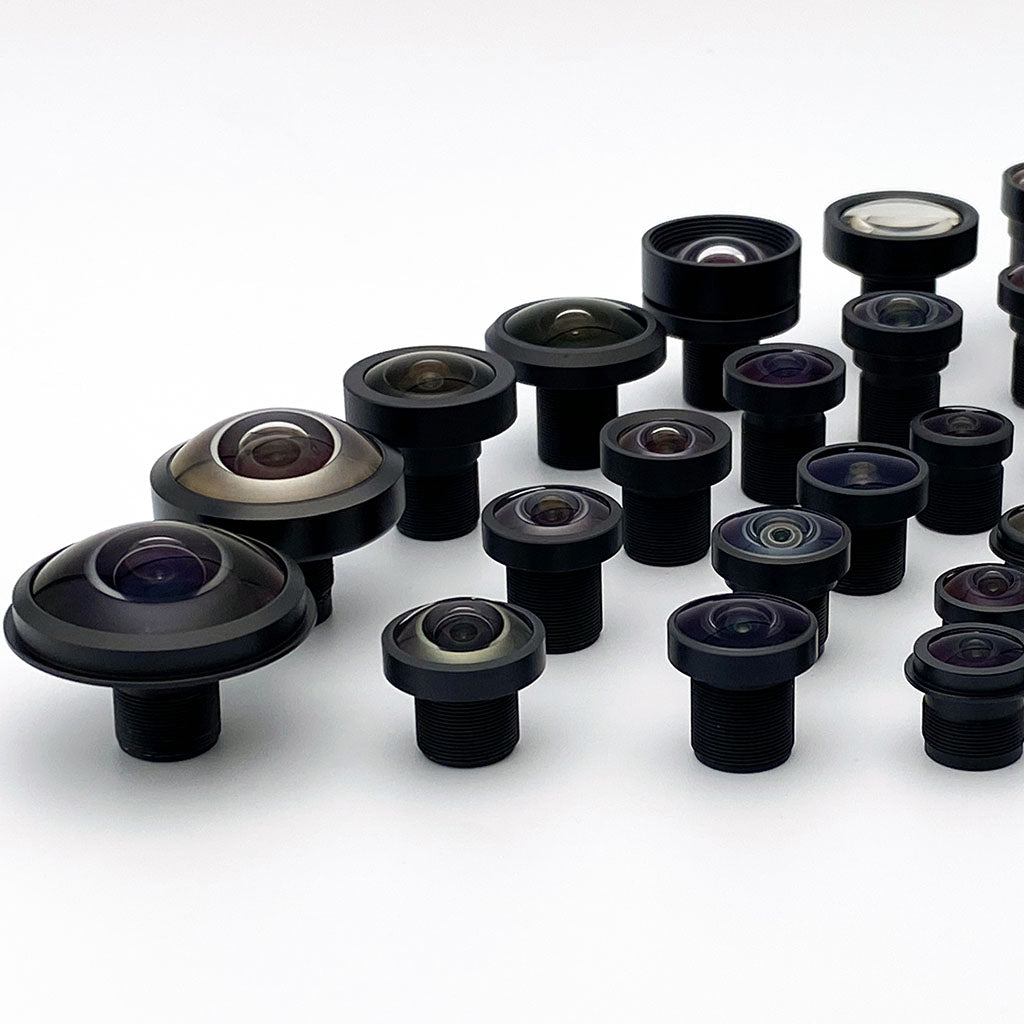

C-마운트 렌즈란 무엇인가? 플랜지 초점 거리, 수동 조리개 제어, CS-마운트 호환성
This guide covers the 1"-32 UN thread and 17.526mm flange focal distance, plus focus mechanisms and the adjustable iris. It also covers CS-mount compatibility and when C-mount beats M12.

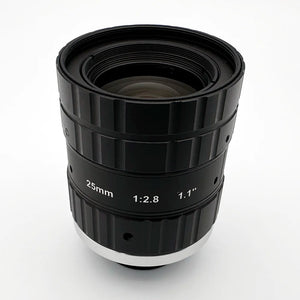
A C-mount lens is a screw-thread lens standard using a 1"-32 UN thread and a fixed 17.526mm flange focal distance (FFD), the distance from the mount flange to the sensor plane. Adjustable C-mount lenses focus by rotating a ring, with the moving elements varying by design, and many include a manual iris ring for aperture control.
C-mount is the default industrial lens mount for machine vision: broad focal length selection, sensor coverage up to 1.2" and beyond on select lenses, and an adjustable iris that most M12 lenses do not have. CS-mount shares the thread with a shorter 12.526mm flange, and M12 is a different, smaller system entirely.
C-마운트 렌즈란 무엇인가요?
A C-mount lens uses a 1"-32 UN thread (one inch outer diameter, 32 threads per inch) and a specified 17.526mm flange focal distance. The thread and flange are the entire mechanical specification. C-mount bodies are machined to that FFD and C-mount lenses are designed against it, which is what makes cross-manufacturer pairing routine. That is nominal geometry, not a guarantee: real parts carry tolerance, and rear-element clearance, focus travel, image circle, and cover-glass thickness stay lens and camera specific.
Focus mechanism belongs to the design, not the mount. Rotating the focus ring on an adjustable C-mount lens may translate the whole optical cell in a helicoid, shift only the front group, or drive internal groups along a cam track. The datasheet for the lens you are evaluating, or a question to Commonlands engineering, settles which, along with how the image behaves at the near limit.
Fixed-focus C-mount products exist too, and all are equally C-mount. That is also different from M12 lenses, which are rigid assemblies focused by threading the whole body in or out.
A lens's specified minimum object distance may reflect available focus travel, image-quality requirements, or both. The measurement reference can vary by manufacturer, so use the drawing or datasheet definition. An extension tube can allow closer focus but changes the operating conditions and may reduce usable image quality. Working distance runs from around 100mm to infinity depending on the product. It is not a single fixed range across the catalog.
Beyond thread and flange, the standard says nothing about optical performance or sensor coverage. A 2.8mm wide lens and a 75mm telephoto are both C-mount. The mount is a mechanical interface, not a performance tier.
The nominal C-mount flange focal distance is 17.526mm. Use the camera and lens mechanical drawings to establish the allowed axial and angular variation from the mounting datum. The nominal dimension alone is not a tolerance specification. Where a camera's registration or cover glass sits off nominal, expect to refocus or shim.

What Is a CS-Mount Lens?
A CS-mount lens shares the same 1"-32 UN thread as a C-mount lens but uses a shorter 12.526mm flange focal distance instead of 17.526mm. The 5mm shorter optical path lets designers work with shorter back focal lengths, which is design freedom rather than a guaranteed simplification: element count and spectral correction follow from the prescription, field, aperture, and conjugates, not from the flange.
It is not a smaller version of C-mount optically. The flange geometry drives the whole lens design. Because the thread is identical, either lens screws into either body wherever the rear group clears the throat. Whether it focuses is a separate question.
| 매개변수 | CS 마운트 | C-마운트 |
|---|---|---|
| 스레드 | 1"-32 UN | 1"-32 UN |
| 플랜지 초점 거리 | 12.526mm | 17.526mm |
| 일반적인 센서 최대 감지 범위 | ~2/3인치 | 일부 렌즈의 경우 1.2인치 이상 |
| 일반적인 초점 거리 범위 | ~2.5mm~16mm | 2.8mm~100mm+ |
| 일반적인 용도 | CCTV, ITS, 보안, 라즈베리 파이 HQ 프로토타이핑 | 산업용 머신 비전, 과학용 이미징 |
A C-mount lens on a CS-mount camera works with a 5mm C-to-CS spacer adapter that restores the 17.526mm distance. Without it, the flange sits 5mm closer to the sensor than the lens expects: at infinity the image forms behind the sensor plane, and focusing closer moves it further back. No normal focus travel covers a 5mm deficit. Many CS-mount cameras ship with the spacer, and the CLA217-CCS adapter ($6.00) provides the correction.
A CS-mount lens on a C-mount camera loses infinity focus, and no passive spacer brings it back. The sensor sits 17.526mm back, 5mm farther than the lens is designed for, and spacers only add path length, never remove it.
What that extra 5mm does is act as an extension tube, so the pairing still focuses at close range, at working distances far shorter than the lens markings suggest. How close it lands is lens-specific, so measure the pairing rather than assume it. For infinity or normal standoff, use C-mount lenses.
CS-mount is common in ITS (intelligent transportation systems) and security cameras, where the shorter flange suits the wide, fast designs those cameras use. Correction at 850nm or 940nm for license-plate and night work is a property of the design, not the mount.
CS is also the native mount on the C/CS version of the Raspberry Pi High Quality Camera, which takes CS-mount lenses directly and C-mount lenses with the 5mm spacer. For most machine vision, particularly sensors above 2/3" or focal lengths above 16mm, C-mount stays the default. Browse the Commonlands CS-mount collection.
What Is a Manual Iris Lens?
A manual iris lens has a physical iris ring the user rotates to set the aperture (F#), then locks. There is no motor and no feedback circuit. That differs from a fixed-iris lens, common on M12, where aperture is set at the factory. It also differs from an auto-iris lens, which uses an electronic actuator to track scene brightness.
Manual iris is common on C-mount machine vision lenses, but iris type is a lens feature, not part of the mount: fixed, manual, DC auto-iris, P-iris, and motorized C-mount lenses all exist.
Adjustable iris control is the single biggest practical advantage of C-mount over M12 for machine vision. Stopping down raises depth of field. Opening the iris lowers it. Because machine vision illumination is usually LED-based and programmable, engineers can stop down to gain depth of field and then drive the lighting harder to recover the lost throughput. That tradeoff is impractical in ambient-light photography but routine on a production line. Commonlands C-mount lenses carry a manual iris for exactly this control.
| 아이리스 유형 | 조리개 값은 누가 설정하나요? | 일반적인 용도 |
|---|---|---|
| 수동 조리개 | 배포 전에 링이 있는 사용자가 잠겨 있음 | 프로그래밍 가능한 조명이 탑재된 C-마운트 머신 비전 |
| 고정식 조리개 | 공장 출하 시 설정된 값이며, 조정할 수 없습니다. | M12 임베디드 및 저비용 애플리케이션 |
| 자동 조리개 | 장소의 밝기에 반응하는 전자식 액추에이터 | 실외 CCTV, 가변 조도 감시 |
What Is an Industrial Lens?
An industrial lens is a lens selected for machine vision, robotics, automation, inspection, or scientific imaging, where image geometry and repeatability matter more than photographic look. The term is not tied to one mount or price point. It names a set of engineering priorities. Repeatable geometry comes first: once focused and locked, field of view and distortion should stay constant across units and production runs, because a calibrated algorithm cannot tolerate geometry that shifts by serial number.
The table describes what is typical of each category, not what any mount or standard requires. Individual products cross the lines.
| 속성 | 산업용 렌즈 | 소비자용 렌즈 | CCTV 렌즈 |
|---|---|---|---|
| 왜곡 사양 | 발표 및 특성 분석 | 머신 비전 분야에서는 종종 명시되지 않음 | 거의 명시되지 않으며, 대개 더 높은 편이다 |
| 조리개 제어 | 수동 조리개(C-마운트) 또는 고정형(M12) | Usually electronic, via the camera body | Manual iris, DC auto-iris, or fixed |
| 초점 고정 | 고정 나사 또는 잠금 링 | Usually none. Most are autofocus | 때로는, 종종 마찰만 있을 때도 |
| 표준 마운트 | C-마운트, CS-마운트, M12 | Camera-brand mounts (E, F, RF, L) | C-마운트, CS-마운트 |
C-mount and M12 are the two dominant industrial mounts, with CS-mount a close variant of C-mount on a 5mm shorter flange. Neither C-mount nor M12 is universally better. Choose on sensor size, aperture control, and packaging. Commonlands makes lenses in all three mounts, and the C-mount vs M12 comparison below covers the decision.
Sensor Size and Image Circle Coverage
C-mount specifies the mechanical interface, not sensor coverage. Coverage is set by the lens image circle, the diameter of the usable projected image at the focal plane. If the image circle is smaller than the sensor diagonal, the corners go dark, a defect called vignetting. Corners can also go soft where the field exceeds the lens's corrected image circle, a separate resolution effect. Always check image circle against sensor diagonal, or pick a lens rated for a larger format than you need.
| 센서 형식 | 대각선 길이(약) | 일반적인 렌즈 등급 |
|---|---|---|
| 1/3인치 | 6.0mm | C-마운트, CS-마운트, CCTV 항목 |
| 1/2인치 | 8.0mm | 중급형 M12 및 C-마운트 |
| 2/3인치 | ~11.0mm | 표준 산업용 C-마운트 |
| 1" | ~16.0mm | 고해상도 C-마운트 |
| 1.1" | ~17.6mm | 고해상도 12~25MP 산업용 |
Corner performance is not uniform even within a rating. Commonlands publishes an image circle for every C-mount and CS-mount lens, so the check against your sensor diagonal is direct. See the sensor size and lens compatibility guide for format matching.
C-Mount vs M12: Which Should You Choose?
Choose C-mount when you need an adjustable iris for depth-of-field control, sensor coverage above roughly 1/1.8", or focal lengths past 50mm. Choose M12 when size, weight, and cost dominate: embedded cameras, drones, and small robotics platforms are its natural home. C-mount and M12 are different focus systems, not scaled versions of each other.
Mount type does not establish element count, mechanical tolerance, or price. Compare the actual lenses and their focus, iris, image-circle, and image-quality specifications. The bigger factor is integration: C-mount's standardized flange gives a lens and camera from separate vendors the same nominal registration, while M12 back focal length varies enough that every pairing must be checked against the holder height in the datasheet.
For the full mount comparison including M8, see the lens mount guide, and browse the Commonlands M12 lens collection for compact options.
Top 5 C-Mount and CS-Mount Lenses for Machine Vision
The five Commonlands lenses below cover common C-mount machine vision roles, from an 8mm wide-area lens (CIL531, 2/3", F/2.8) to a 25mm high-resolution option for 1.1" 20MP sensors (CIL544, F/1.8). The CIL725 2.5mm fisheye is CS-mount, included for Raspberry Pi HQ and panoramic builds. Every lens carries an adjustable iris, the control that separates C-mount from most M12 optics.
| 순위 | 렌즈 | 마운트 | EFL | F# / 아이리스 | 포맷 범위 | 다음에 가장 적합합니다 |
|---|---|---|---|---|---|---|
| 1 | CIL531 8mm | C-마운트 | 8mm | F/2.8, adjustable | 최대 2/3인치, 1,200만 화소 | 광역 오버헤드 로봇 공학 및 대면적 검사 |
| 2 | CIL522 12mm | C-마운트 | 12mm | F/1.4, adjustable | 최대 2/3인치, 4.2 마이크론에서 3MP | 밝은 범용 검사 기준선 |
| 3 | CIL535 35mm | C-마운트 | 35mm | F/2.0~F/16, 조절 가능 | 최대 2/3인치, 2.2 마이크론에서 1,200만 화소 | 더 긴 스탠드오프 컨베이어 및 갠트리 검사 |
| 4 | CIL544 25mm | C-마운트 | 25mm | F/1.8, 조절 가능 | 1.1인치, 2.74 마이크론 크기의 2,000만 화소 이상 | 대형 센서에 대한 고해상도 측정 |
| 5 | CIL725 2.5mm | CS 마운트 | 2.5mm | F/1.8-F/14, adjustable | 6.4mm image circle. A complete circular image requires a sensor short side of at least 6.4mm. A smaller short side crops the circle | 파노라마 및 라즈베리 파이 HQ 빌드 |
How we picked: every lens is stocked at Commonlands with a published image circle and an adjustable iris, and each fills a distinct role so the five span wide-area through high-resolution work. Size focal length from your working distance and sensor width in the EFL calculator, and confirm image circle against your sensor diagonal before ordering.
후지논(Fujinon), 코와(Kowa), 컴퓨타(Computar)는 C-마운트 FA 렌즈 분야의 대표적인 제조사이며, 에드먼드 옵틱스(Edmund Optics)는 자사의 TECHSPEC 라인을 통해 폭넓은 C-마운트 제품군을 취급하고 있습니다. 이들 업체는 장초점 거리 및 1.1인치 이상의 포맷 분야에서 제품 라인업이 더욱 다양하기 때문에, 해당 분야에서는 여전히 기준이 되는 업체로 자리 잡고 있습니다. 커먼랜즈(Commonlands)는 경쟁력 있는 가격, 샌디에이고 현지 재고를 통한 당일 출고, 그리고 광학 제품을 사양하는 엔지니어와의 직접적인 소통을 통해 경쟁력을 확보하고 있습니다.

자주 묻는 질문
Commonlands C-mount lenses pair a manual iris with working distances from typically 100mm to infinity. These answers cover the standard behind them.
C-마운트 렌즈란 무엇인가요?
A C-mount lens is a screw-thread lens using 1"-32 UN thread and a 17.526mm flange focal distance. The standard defines the mechanical interface between lens and camera body, so lenses and cameras from different manufacturers start at the same nominal registration. Focus tolerance, rear-element clearance, image circle, and the camera's sensor stack still have to be checked per pairing. Many include an adjustable iris ring, and adjustable models focus by ring rotation. Which elements move and how focus behaves at the near limit differ from design to design.
C-마운트 렌즈의 플랜지 초점 거리는 얼마입니까?
17.526mm, measured from the lens mount flange to the sensor plane. C-mount camera bodies are machined to this distance, and C-mount lenses are designed with a matching flange focal distance. CS-mount uses the same thread with a 12.526mm flange instead, a 5mm difference that governs adapter use.
C-마운트 렌즈를 CS-마운트 카메라에 사용할 수 있나요?
Yes, with a 5mm C-to-CS spacer adapter that restores the 17.526mm flange distance. Without it, the flange sits 5mm closer to the sensor than the lens expects, the image forms behind the sensor plane, and no normal focus travel covers a 5mm deficit. Many CS-mount industrial cameras ship with this spacer included. The CLA217-CCS adapter provides the correction for $6.00.
CS 마운트 렌즈를 C 마운트 카메라에 사용할 수 있나요?
Not for normal use. A CS-mount lens is designed for a 12.526mm flange distance, and a C-mount camera places the sensor 17.526mm back. Spacers only add optical path length, and none can shorten it, so infinity focus is gone and no passive spacer restores it. The extra 5mm behaves like an extension tube, so the pairing still focuses at close range, well inside the lens's marked distances, though how close depends on the lens. Treat it as a macro workaround rather than a compatible combination.
어떤 경우에 M12 대신 C-마운트를 선택해야 할까요?
피사계 심도 조절을 위한 조리개 조절 기능이 필요하거나, 약 1/1.8" 이상의 센서 커버리지가 필요하거나, 50mm를 초과하는 초점 거리를 포함한 광범위한 초점 거리 범위가 필요한 경우에는 C-마운트를 선택하십시오. 임베디드 카메라, 드론, 소형 로봇 플랫폼 등 크기, 무게, 비용이 주요 제약 조건인 경우에는 M12를 선택하십시오. 자세한 내용은 렌즈 마운트 가이드를 참조하십시오.
Need Help Choosing a C-Mount Lens?
Commonlands manufactures C-mount, CS-mount, and M12 lenses for machine vision and embedded vision. Lens designs are MTF characterized against design specifications. Send our San Diego engineering team your sensor model and application at engineering@commonlands.com or call +1 (858) 333-7325. Orders placed before 12 PM PT ship same day.