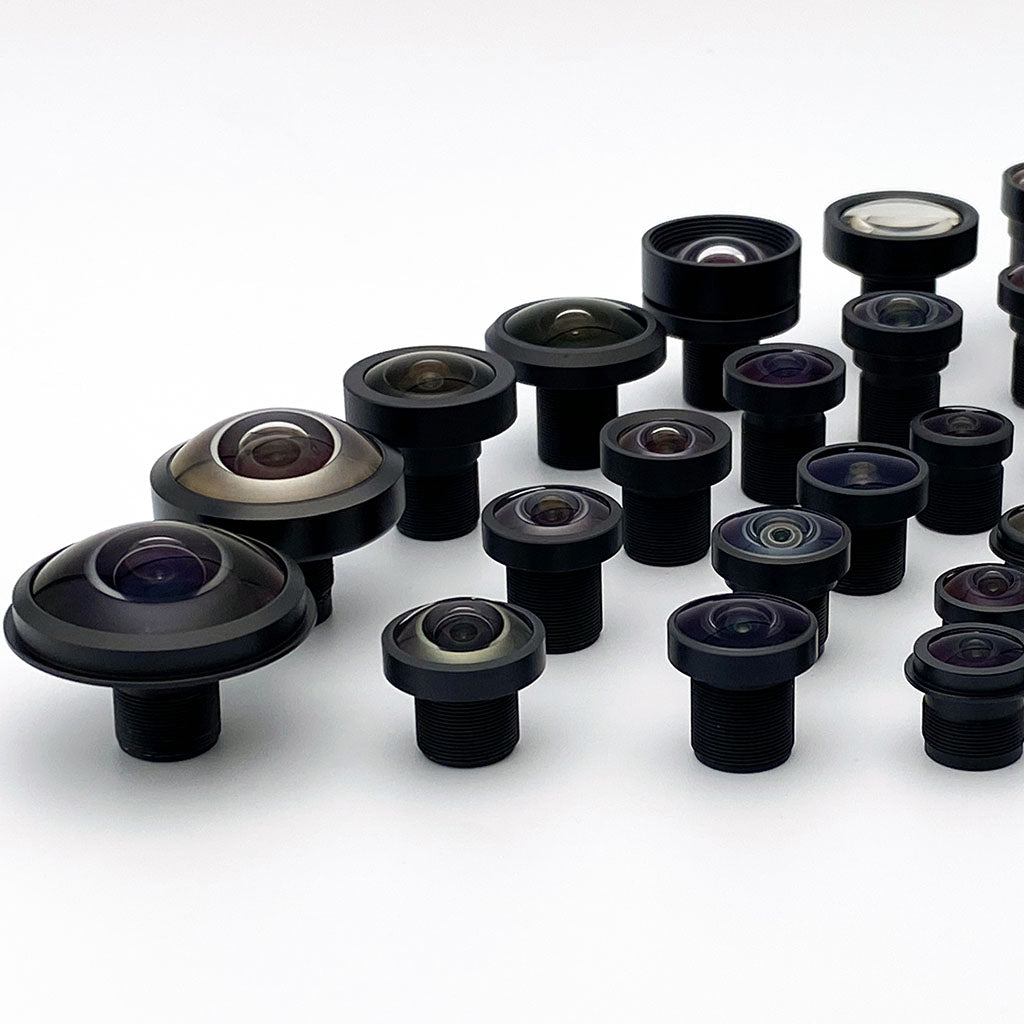

머신 비전에서의 센서 크기와 렌즈 호환성: 이미지 서클, 비네팅, 상대 조도
This guide shows how to match a lens to a sensor: coverage math, vignetting mechanisms, and the relative illumination curve that combines them.

A lens matches a sensor when its image circle diameter equals or exceeds the sensor diagonal, with margin left for corner sharpness. That comparison is necessary but not sufficient, and the image circle figure means little without its criterion. After coverage you still check mechanical vignetting, aperture-dependent optical vignetting, the natural falloff of the projection that cos4 models to first order, and chief ray angle (CRA) match to the sensor's microlens array. For sensor format dimensions, naming conventions, and diagonal charts, see the CMOS sensor size guide.
렌즈가 내 센서를 커버하는지 어떻게 알 수 있나요?
Compare the lens image circle diameter to the sensor diagonal. Clearing the diagonal is necessary, not sufficient: an image circle figure means little until you know the criterion behind it, which is the relative illumination or MTF the vendor still holds at that radius, and at which aperture, wavelength, and conjugate. Ask for that criterion. Below the diagonal the corners darken, from shading to black depending on the lens. Calculate the diagonal from the active area, not from the format name.
Coverage on its own says nothing about chief ray angle or mechanics. A mechanical fit (mount, flange distance, rear clearance) and an optical fit (image circle criterion, CRA, relative illumination) both have to hold, and a correct mount does not rule out vignetting.
For a 1/2-inch sensor with a 6.4 × 4.8mm active area: diagonal = √(40.96 + 23.04) = √64 = 8.0mm. That sensor needs an image circle of at least 8.0mm plus margin. Round the diagonal up and the lens's rated image circle down before comparing, so a borderline pairing is judged conservatively.
센서 포맷 참조 및 최소 이미지 서클
Sensor formats Commonlands lenses cover, with the minimum image circle each needs to reach the diagonal.
| 센서 형식 | 일반적인 유효 영역 (mm) | 대각선 길이 (mm) | 최소 화각 | 대표적인 렌즈 종류 |
|---|---|---|---|---|
| 1/4인치 | 3.6 × 2.7 | 4.5 | 4.5mm+ | M12 |
| 1/3인치 | 4.8 × 3.6 | 6.0 | 6.0mm 이상 | M12 |
| 1/2.9인치 | 5.6 × 3.2 | 6.4 | 6.4mm 이상 | M12 |
| 1/2.7인치 | 5.3 × 4.0 | 6.6 | 6.6mm 이상 | M12 |
| 1/2.5인치 | 5.8 × 4.3 | 7.2 | 7.2mm 이상 | M12 |
| 1/2인치 | 6.4 × 4.8 | 8.0 | 8.0mm 이상 | M12 또는 C-마운트 |
| 1/1.8인치 | 7.2 × 5.4 | 9.0 | 9.0mm 이상 | M12 또는 C-마운트 |
| 1/1.7인치 | 7.6 × 5.7 | 9.5 | 9.5mm 이상 | M12 또는 C-마운트 |
| 2/3인치 | 8.8 × 6.6 | 11.0 | 11.0mm 이상 | C-마운트 |
| 1" | 12.8 × 9.6 | 16.0 | 16.0mm 이상 | C-마운트 |
| 1.1" | 14.1 × 10.35 | 17.5 | 17.5mm 이상 | C-마운트 |
Active area varies by manufacturer and model within one format label, so use the exact width and height from the sensor datasheet, or the image sensors database.

머신 비전에서 비네팅 현상은 무엇 때문에 발생하나요?
Vignetting has three mechanisms, each with a different fix. Mechanical vignetting is ray clipping by physical apertures: barrel bores, retainers, filter threads, and the mount cut into off-axis bundles whatever the iris is set to. A published image circle is the usable field that clipping leaves under the vendor's criterion, and illumination or aberration can set that limit first. Beyond the published circle, performance is unspecified: expect gradual shading and aberration growth, with hard clipping only at the mechanical cutoff.
Optical vignetting is aperture-dependent roll-off, from off-axis bundles seeing a smaller effective aperture. It is worst wide open and improves as you stop down, which a C-mount iris ring lets you do. Most M12 lenses have no iris and are fixed at manufacture. Natural falloff is what remains when nothing is clipped, and cos4 models it to first order for a rectilinear lens whose pupil magnification is near one.
At a 20° half-angle, cos4 gives about a 22% drop. At 30°, the drop is about 44%. At 45°, it reaches about 75%. The half-angle that matters for corners is the diagonal one set by the sensor, not the horizontal field, so a lens with a 30° horizontal half-angle has a larger corner angle and a larger loss.
Those figures are a first-order reference, not a floor and not a ceiling. Measured relative illumination sits above or below cos4 depending on projection, pupil aberration, and pupil magnification, and it moves with aperture wherever optical vignetting is also present. Wide-angle and fisheye designs routinely beat the model. A lens with heavy mechanical vignetting falls under it. Read the measured curve.
How to tell the three vignetting mechanisms apart when choosing a Commonlands lens: match the symptom to its mechanism and fix.
| 증상 | 추정되는 작용 기전 | 먼저 확인하세요 | 조리개를 조이면 해결될까요? |
|---|---|---|---|
| 단단하고 검은 모서리, 날카로운 경계 | 기계적 비네팅 | 이미지 서클과 센서 대각선을 비교하기 | Correct the obstructing aperture. A different holder, filter mount, accessory, or lens may be needed |
| 부드러운 방사형 감쇠, 조리개 조임 시 화질이 향상됨 | 광학 비네팅 | Measure relative illumination at multiple F# settings | 네, 아이리스 링이 달린 C-마운트입니다. |
| 부드러운 방사형 감쇠, 조리개 조여도 변함없음 | Natural falloff, modeled to first order by cos4 | Compare the calculated corner (diagonal) half-angle falloff with the measured curve | No. Projection geometry sets it. Stopping down moves the measured curve only where optical vignetting is also present, and magnitude depends on the design |
| 색상 변화와 함께 나타나는 모서리 어두워짐 현상 | CRA 불일치 (아래 참조) | 렌즈의 CRA 곡선과 센서의 마이크로렌즈 사양을 비교한다 | Per-channel calibration can reduce repeatable color shading, but cannot recover lost SNR or arbitrary angular crosstalk |
Flat-field correction rescales what the sensor actually recorded. It cannot recover a corner that read zero or clipped at saturation, it cannot rebuild SNR or MTF that were never captured, and it fails on color-dependent angular crosstalk and on shading that drifts with illuminant, temperature, or focus. Where corner quality drives the pass/fail decision, fix the optics first and treat correction as cleanup, not the primary fix.
렌즈에서 상대 조도란 무엇인가요?
Relative illumination is the normalized brightness at a field position, expressed as a ratio to the on-axis illuminance. A lens at 70% relative illumination in the corner delivers 30% less light there than at center under the same exposure. It is the lens-side curve that combines mechanical vignetting, optical vignetting, and cos4 falloff. Sensor microlens CRA mismatch adds corner falloff at the camera-system level, not within the lens curve itself unless it is measured through the sensor.
A low distortion spec does not buy corner brightness: a lens under 0.2% distortion can still sit at 50% relative illumination at the corner, so check both specs separately for dimensional work.
What feeds the relative illumination curve on a Commonlands M12 or C-mount lens, and what changes each contributor.
| 기여 메커니즘 | 변경 사항 | 이 문제를 해결하는 방법은 무엇인가요? |
|---|---|---|
| Natural roll-off (cos4 model) | To first order, illuminance falls as the fourth power of the cosine of the field half-angle under rectilinear projection. Measured curves land above or below the model depending on projection, pupil aberration, and pupil magnification | Largely fixed by projection geometry for rectilinear designs. Accept it or choose a longer focal length, or a lens whose projection is intentionally engineered to reduce it |
| 광학(조리개) 비네팅 | 사선 광선 다발은 축소된 유효 구경을 보게 된다 | Stop down the iris on C-mount. Most M12 lenses are fixed at design |
| 기계적 비네팅 | Barrels, retainers, and mount bores clip off-axis bundles. The rated image circle marks where usable field ends under the vendor's criterion | Use a lens with a larger rated image circle, and confirm the criterion behind that rating |
| CRA 불일치 | 모서리 부분의 주광선 각도가 센서 마이크로렌즈 설계와 일치하지 않음 | 센서 사양에 맞는 CRA 프로파일이 적용된 렌즈를 선택하십시오. |
| 필터/윈도우 스택 | An interference coating's passband shifts and broadens with incidence angle, and every ray in the f-number cone at a field point arrives at a different angle, so the full cone sets the shift while the chief ray only marks its center. Fresnel loss also rises at those angles, and a plane plate in converging light adds aberration | Specify filters against the corner cone angles and the band actually in use, not the chief ray alone. A slower cone or an angle-tolerant coating narrows the spread |
이미지 서클이 충분히 커지면 CRA가 중요한가요?
Yes. Chief ray angle (CRA) is the angle at which the principal ray reaches the sensor at a given field position: near zero at center, oblique at the corners. CMOS sensors have microlens arrays shaped for a CRA profile that varies with field height, so a corner mismatch steers light away from the photodiode and corner sensitivity drops.
Request the lens CRA profile at 0°, half-field, and full-field, and compare it against the sensor's microlens CRA at the same heights. A full-field mismatch beyond the sensor's rated CRA acceptance tolerance produces measurable corner shading. That tolerance is sensor-specific, so read it from the sensor datasheet rather than assuming a threshold. Ask the manufacturer if it is not published. Commonlands supplies CRA data where available for its M12 and C-mount lenses.
피쉬아이 필 팩터: 촬영 범위 규칙에 대한 의도적인 예외
Standard lenses are specified so the image circle covers the sensor diagonal. Fisheye systems deliberately vary that ratio, because a fisheye still has a defined image circle. A complete circular image needs the circle to fit inside the sensor's short dimension, not just the diagonal, so a circle can clear the diagonal and still be clipped top and bottom.
How a Commonlands fisheye lens fills different sensors, set by the image-circle-to-sensor ratio.
| 채우기 모드 | 이미지 서클 대 센서 | 센서가 포착하는 것 | 일반적인 용도 |
|---|---|---|---|
| 원형 어안 렌즈 | 이미지 서클이 센서의 짧은 변보다 작음 | Complete circular image with black corners. Maximum fisheye FOV visible | 360도 촬영, 파노라마 촬영 |
| 풀프레임 어안 렌즈 | 센서 대각선과 일치하거나 그보다 약간 위쪽에 위치한 이미지 서클 | 피쉬아이 화각으로 촬영된 콘텐츠가 화면 가장자리부터 가장자리까지 가득 채웁니다. | SLAM, 로봇공학, 서라운드 뷰 시스템 |
| 크롭된 어안 렌즈 | 이미지 서클이 센서 대각선 길이보다 큼 | Sensor captures only the central region. Narrower effective FOV, with the high-distortion outer field cropped out rather than corrected | 적당한 시야각(FOV)의 광각 어안 렌즈를 사용한 소형 임베디드 빌드 |
다양한 형식의 커먼랜즈 제품 사례
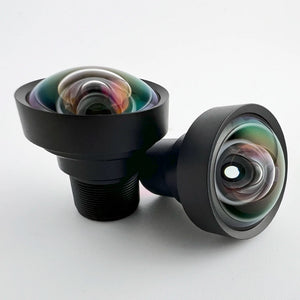
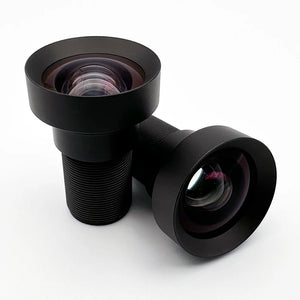
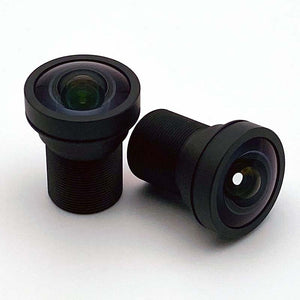
These Commonlands lenses show how image circle, sensor format, and mount scale together.
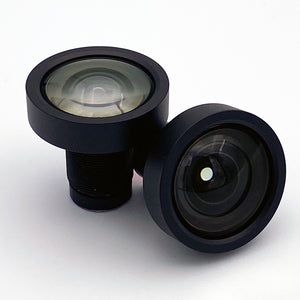
센서 형식별 추천 렌즈
This table maps common formats to a Commonlands lens whose published image circle clears the sensor diagonal, reusing the diagonals from the reference table above.
| 센서 형식 | 대각선 길이 (mm) | 센서 예시 / 용도 | 추천하는 커먼랜즈 렌즈 | 렌즈의 화각 |
|---|---|---|---|---|
| 1/4인치 | 4.5 | 저비용 감시, 웹캠 | CIL343 4.4mm M12 | 8.8mm-9.7mm. Oversized for 1/4" |
| 1/3인치 | 6.0 | 방범 카메라, 드론 | CIL062 6mm M12 | 9.0mm |
| 1/2인치 | 8.0 | 컴팩트 카메라, 드론 | CIL085 8mm M12 | 8.9mm |
| 2/3인치 | 11.0 | 글로벌 셔터 방식 머신 비전 | CIL522 12mm C-마운트 | 11.4mm |
| 1" | 16.0 | 글로벌 셔터 방식 머신 비전 | CIL544 25mm C-마운트 | 17.6mm |
The CIL544 covers 1.1-inch sensors, the top of the Commonlands C-mount range. Large-format C-mount lenses from Fujinon, Kowa, or Edmund Optics reach 4/3-inch. Larger formats such as APS-C require a lens image circle and ray clearance suitable for the active area. The sensor diagonal does not need to fit through the mount bore. Check off-axis ray clearance through the mount and filters, along with image quality across the field. Larger mounts are common for these formats.

자주 묻는 질문
These answers apply to any lens and sensor pair. Commonlands lists image circle in millimeters for its M12 and C-mount lenses.
이미지 서클이 충분히 커지면 CRA가 중요한가요?
네. 주광선각은 센서 모서리에서 빛이 렌즈를 빠져나가는 각도를 나타냅니다. 이 각도가 센서의 마이크로렌즈 어레이 설계 각도와 일치하지 않으면, 마이크로렌즈가 해당 빛을 포토다이오드에 효율적으로 집중시킬 수 없습니다. 그 결과, 이미지 서클이 센서를 완전히 덮고 있더라도 모서리 부분의 어두워짐이나 색상 편차가 발생합니다. 이러한 불일치는 고해상도 센서에 광각 M12 렌즈를 장착했을 때 가장 흔히 발생합니다.
플랫 필드 보정으로 렌즈 비네팅을 해결할 수 있나요?
Flat-field correction normalizes brightness by dividing each pixel by a gain factor from a reference white image, and it removes the visible appearance of corner darkening. It cannot restore photons or signal-to-noise ratio that were never collected: a corner receiving 50% of center illumination has its signal and its noise amplified by the same gain factor, so corner SNR is unchanged by the correction. It cannot recover a corner that read zero or clipped at saturation.
이미지 서클이 클수록 항상 더 좋은 것일까?
A larger image circle can place the sensor inside a better-corrected region, but it does not guarantee better edge MTF, illumination, or CRA matching. Compare those measurements at the same sensor size, aperture, wavelength, and working distance. Include alignment tolerances and the manufacturer's image-circle definition when deciding how much coverage margin is needed.
1/3인치 렌즈를 1/2인치 센서에 장착해도 될까요?
Typically not without vignetting. A 1/3-inch format lens has an image circle around 6.0mm, and a 1/2-inch sensor has a diagonal around 8.0mm. The sensor corner sits at a radius of 4.0mm while the published circle's edge is at a radius of 3.0mm, so the corners sit about 1mm outside the published circle, where performance is unspecified: expect gradual shading and aberration growth, with hard clipping only at the mechanical cutoff.
왜 어안 렌즈는 센서 크기에 따라 다른 특성을 보일까요?
The sensor samples a different portion of the fisheye image circle. A complete circular image requires the circle to fit within the sensor's short dimension. A full-frame fisheye covers the diagonal, while a smaller sensor crops the available field. Use the lens's projection data to calculate the resulting angles rather than the rectilinear formula.
센서에 맞는 렌즈를 고르는 데 도움이 필요하신가요?
커먼랜즈는 자사의 M12 및 C-마운트 렌즈에 대한 이미지 서클 사양과, 해당 정보가 제공되는 경우 상대 조도 및 CRA 데이터를 공개하고 있습니다. 센서 부품 번호와 작업 거리를 알려주시면, 해당 영역을 여유 있게 커버할 수 있는 렌즈를 안내해 드리겠습니다.