
텔레센트릭 렌즈란 무엇인가? 피사체 공간 텔레센트릭성, 원근 오차 및 머신 비전 대안
This guide explains object-space telecentricity, image-space telecentricity, and perspective error. It also covers when a standard M12 or C-mount lens is the right choice instead.

A telecentric lens is a lens in which the chief rays on at least one side of the system run parallel to the optical axis instead of converging toward a finite point. In the object-space form used for machine vision metrology, the entrance pupil sits at optical infinity, so apparent object size stays constant as the object shifts slightly in depth.
Telecentric lenses are not a Commonlands product. This page explains the concept so engineers can decide whether they need one or whether a standard M12 or C-mount lens already solves the problem.
물체-공간 텔레센트릭성이란 무엇인가요?
피사체 공간 텔레센트릭성은 입사 동공이 피사체 측의 광학적 무한점에 위치하는 렌즈의 특성입니다. 모든 화점의 주광선은 렌즈에 들어오기 전에 광축과 평행하게 이동하므로, 피사체가 렌즈에 약간 더 가까이 다가오거나 멀어지더라도 동일한 초점 거리를 가진 표준 렌즈에 비해 배율이 훨씬 더 일정하게 유지됩니다.
The entrance pupil is the image of the aperture stop seen from the object side. In a standard lens it sits at a finite distance. As a result, a chief ray's angle of arrival changes when the object moves axially, and apparent size changes with it. Placing the aperture stop at the rear focal plane of the front group maps that pupil to infinity and holds the object-side chief rays parallel.
No lens is perfectly telecentric across the full field at every distance. Telecentric error is specified as a maximum chief-ray angle in degrees, milliradians, or arc-minutes, and checked against the measurement tolerance for tight metrology work.
Pupil location and aperture size are independent. The entrance pupil position sets telecentricity. F# sets depth of field and light throughput. An object-space telecentric lens can be built with a wide or narrow aperture. The stop location, not its diameter, is what makes the design telecentric.
The geometry also costs size: the front element must be at least as large as the object field, so a lens covering a 50mm field needs a front element of at least 50mm. Aperture is a separate decision. Many telecentric gauging setups do run at a high F# with bright LED backlighting, but that follows from wanting depth of field and edge stability at the measurement plane, not from the size of the front element.
Object-space telecentricity does not increase depth of field. At a given magnification, depth of field depends on F#, the blur criterion you set (commonly scaled to pixel pitch), the wavelength and diffraction, and the lens's through-focus behavior, the same as any lens (estimate it with the depth-of-field calculator). What it changes is how reliably an object measures the same size across that depth, which dimensional measurement relies on and most detection tasks can do without, though stable magnification and reduced perspective shift can still help detection.

이미지 공간 텔레센트릭성이란 무엇인가요?
이미지 공간 텔레센트릭성은 출사동공이 이미지 측의 광학적 무한점에 위치하는 렌즈의 특성입니다. 주광선은 모서리를 향해 갈수록 각도가 점점 가팔라지는 대신, 전체 화각에 걸쳐 센서에 거의 수직으로 도달합니다. 이는 측정 정확도와는 무관한 센서 결합 특성이며, 피사체 거리 대비 배율을 안정화시키지는 않습니다.
Both pupils are images of the same aperture stop. In most lenses they sit at finite distances, so the chief ray angle (CRA) at the sensor increases with field position, reaching 20°–30° at the corners of compact small-format modules, the steepest designs in common use. Placing the aperture stop at the front focal plane of the rear group sends the exit pupil to infinity instead.
The benefit is at the sensor. CMOS sensors use microlenses shifted from center to corner to match an expected CRA profile. A mismatch in either direction costs light, whether the rays arrive steeper or shallower than the design expects. That produces shading, and on color sensors, it also shifts corner color. Holding incidence near zero helps only when the sensor is specified for a near-0° CRA.
이미지 공간의 텔레센트릭성은 피사체 거리 대비 일정한 배율을 보장하지 않으며, 피사체 공간의 텔레센트릭성은 센서에서 거의 수직에 가까운 주광선의 입사각을 보장하지 않습니다. 이는 서로 독립적인 문제를 해결하는 독립적인 특성들입니다. 두 가지 특성을 모두 필요로 하는 응용 분야에서는 이중 텔레센트릭 렌즈가 필요합니다.
Image-space telecentricity does not fix distortion or MTF. Evaluate those separately. To decide whether you need it, compare the sensor's maximum CRA spec at the image corner to the lens's expected CRA there. Commonlands M12 and C-mount lenses target the small- and medium-format sensors common in embedded vision, so check the sensor's published CRA profile rather than assuming the format decides it.
투시 오류란 무엇인가요?
Perspective error is the measurement error that occurs when a conventional entocentric lens views a scene through an angular field of view. Because all chief rays converge toward a single entrance pupil at a finite distance, a feature at one working distance subtends a different angle and measures a different size than the same feature slightly closer or farther from the lens. It is a consequence of projection geometry, not a lens aberration.
This is why perspective error and lens distortion are different problems. Distortion is a fixed optical aberration that misplaces image points relative to an ideal rectilinear grid. It is repeatable and can be characterized and removed through calibration. Perspective error depends on the 3D position of each scene point, which changes from part to part, so no fixed calibration removes it. A lens can measure less than 0.1% distortion and still produce substantial perspective error if part height or working distance varies.
| 오류 유형 | 근본 원인 | 변경 사항 | 일반적인 해결 방법 |
|---|---|---|---|
| 렌즈 왜곡 | 렌즈 요소의 광학 수차 | 이미지 픽셀 위치와 이상적인 직선 격자의 비교 | Low-distortion lens. Software calibration |
| 원근법 오류 | 각도 시야, 중심 투영 | 피사체 거리가 변할 때의 배율 | Object-space telecentric lens. Fixed flat scene at constant working distance |
| 시차 오류 (관련) | Central projection through a finite entrance pupil, combined with scene depth | 키에 따라 특징이 옆으로 치우쳐 보이는 현상 | Object-space telecentric lens. Controlled, fixed working distance |
For a rough estimate, the magnification change across a height variation h at working distance d is approximately h/(d - f), which simplifies to h/d when the working distance is large relative to focal length. A 5mm tall part at 200mm introduces roughly 2.5% variation between its near and far faces. Whether that is acceptable depends on the tolerance, and for sub-pixel metrology it usually is not. Use the field-of-view calculator to check magnification at your working distance.
It shows up most in tall or tilted parts and in setups with variable working distance, and is largely irrelevant for flat parts at a fixed working distance or for presence/absence checks.
A related effect is parallax error: the same projection that changes apparent size with depth also shifts an off-axis feature laterally in proportion to its height. Both are addressed the same way, by fixing working distance mechanically where possible and moving to object-space telecentric optics when fixturing cannot hold depth inside the tolerance budget.
내부 중심 렌즈란 무엇인가요?
An entocentric lens is a conventional lens in which all chief rays converge toward a single entrance pupil at a finite distance. Objects farther from the lens appear smaller in the image. This central projection is the standard behavior of ordinary lenses, and the term entocentric simply describes it. It does not imply lower quality.
That pupil is the image of the aperture stop seen from the object side, so it can be real or virtual and can sit ahead of the front element, behind the rear one, or anywhere between. Retrofocus wide-angle designs commonly place it outside the glass. What makes a lens entocentric is the finite pupil distance, not where the pupil lands. Most M12 and C-mount lenses used in machine vision are entocentric unless a product page explicitly states otherwise.
The thin-lens relationship shows why magnification tracks distance: image height equals focal length times object height, divided by (object distance minus focal length). Focused at one working distance, magnification is fixed there, but if the object shifts even a few millimeters, image height changes with it. For a 50mm lens at a 500mm working distance, a 5mm shift changes magnification by roughly 1.1%, which can matter for a system targeting sub-1% accuracy.
Entocentric lenses remain the right default for most machine vision work. Commonlands supplies M12 and C-mount entocentric optics for general inspection, assembly verification, robotic guidance, and barcode or QR reading. They also cover flat or nearly flat parts imaged at a consistent working distance, and wide fields of view where a telecentric front element would grow large and expensive.
Entocentric lenses can still support dimensional measurement when scene geometry is favorable, with careful calibration. The limiting factor is whether depth variation in the scene stays inside the measurement tolerance.
텔레센트릭 렌즈와 엔토센트릭 렌즈: 주요 차이점
The three telecentric configurations are easy to conflate. This table separates them by which pupil sits at infinity and which problem each solves.
| 구성 | 무한원점의 동공 | 통제되는 것 | 중요한 부분 |
|---|---|---|---|
| 물체-공간 텔레센트릭 | 입사 동공 | 배율 대 피사체 거리 | 치수 측정, 게이지 측정, 높이 변동이 있는 부품 |
| 이미지 공간 텔레센트릭 | 출구 동공 | 센서에서의 주광선 각도 | Sensors whose CRA profile the lens has to match |
| 이중 텔레센트릭 | 둘 다 | 위의 두 가지가 동시에 | 균일한 센서 결합이 필요한 고정밀 계측 |
| 내중심적 (표준) | 둘 다 아님 | 명시적으로 제한된 사항은 없음 | 일반 감지, 검사, 로봇 공학, 바코드 판독 |
When a machine-vision catalog says "telecentric" without qualification, it means the object-space form unless stated otherwise. If a vendor lists "bi-telecentric," verify it against the exit pupil specification. Telecentricity, MTF, and distortion are independent specifications, and none substitutes for the others. Where the tolerance budget allows, Commonlands M12 and C-mount entocentric optics cover the same work at lower cost and size.
Telecentric or standard: how to choose
Telecentric lenses solve one problem: magnification stability when object depth cannot be perfectly controlled. The clearest cases are precision dimensional gauging where parts cannot sit at a fixed distance, height-variation inspection where thickness differences or board warp would shift apparent dimensions into false accepts or rejects, and metrology that must hold calibration over long runs despite small drift along the Z axis.
The common factor is depth variation that cannot be removed mechanically. Telecentric optics earn their place when perspective error is a significant fraction of tolerance, not because telecentricity reads as a premium feature.
Build the error budget in one common unit, such as micrometers in object space. Convert depth variation, fixture repeatability, calibration residuals, and telecentricity error into measurement error using the system geometry. Measure how blur affects the chosen edge or feature estimator. Combine the terms using a stated worst-case method, or a statistical method when their distributions and independence are justified.
Most applications do not clear that bar, and a standard low-distortion lens is the right answer more often than engineers assume:
- Detection, presence-absence, and classification, where tight dimensional measurement is not required.
- Parts fixtured accurately enough that depth variation stays small relative to working distance.
- Setups needing working-distance flexibility, when the selected telecentric lens is specified for a fixed working distance. Adjustable-working-distance and variable-magnification telecentric designs also exist, so check the product range.
- Deployments where size, weight, or cost rules out a large telecentric front element.
Check magnification with the field-of-view calculator and focal length with the EFL calculator. The Commonlands engineering team can run that tolerance math for a standard M12 or C-mount alternative.
텔레센트릭 렌즈 제조사: 구매처
Commonlands does not stock telecentric lenses. The manufacturers below are established sources for object-space and bi-telecentric optics in industrial machine vision.
| 제조사 | 본사 | 제품 소개 | ~로 잘 알려진 |
|---|---|---|---|
| 옵토 엔지니어링 | 이탈리아 | 전용 텔레센트릭 및 머신 비전 광학 장치 | 물체 공간 및 이중 텔레센트릭 제품군을 아우르는 광범위한 텔레센트릭 제품 카탈로그 |
| 에드먼드 옵틱스 | 미국 | 광학 제품 카탈로그 및 머신 비전용 렌즈 | TECHSPEC 테레센트릭 제품군, 풍부한 재고, 신속한 배송 |
| VS 테크놀로지 | 일본 | 머신 비전용 렌즈 | 텔레센트릭 및 고해상도 산업용 렌즈 |
| 모리텍스 | 일본 | 머신 비전용 광학 장치 및 조명 | 적합한 조명과 조합된 텔레센트릭 렌즈 |
| Sill Optics | 독일 | 텔레센트릭, 스캔 및 f-theta 광학계 | 텔레센트릭 측정 렌즈 및 맞춤형 설계 |
| 컴퓨타르 | 일본 | 머신 비전 및 CCTV용 렌즈 | 표준 렌즈와 함께 제공되는 초급용 텔레센트릭 제품군 |
커먼랜즈의 표준 렌즈 대안 제품들
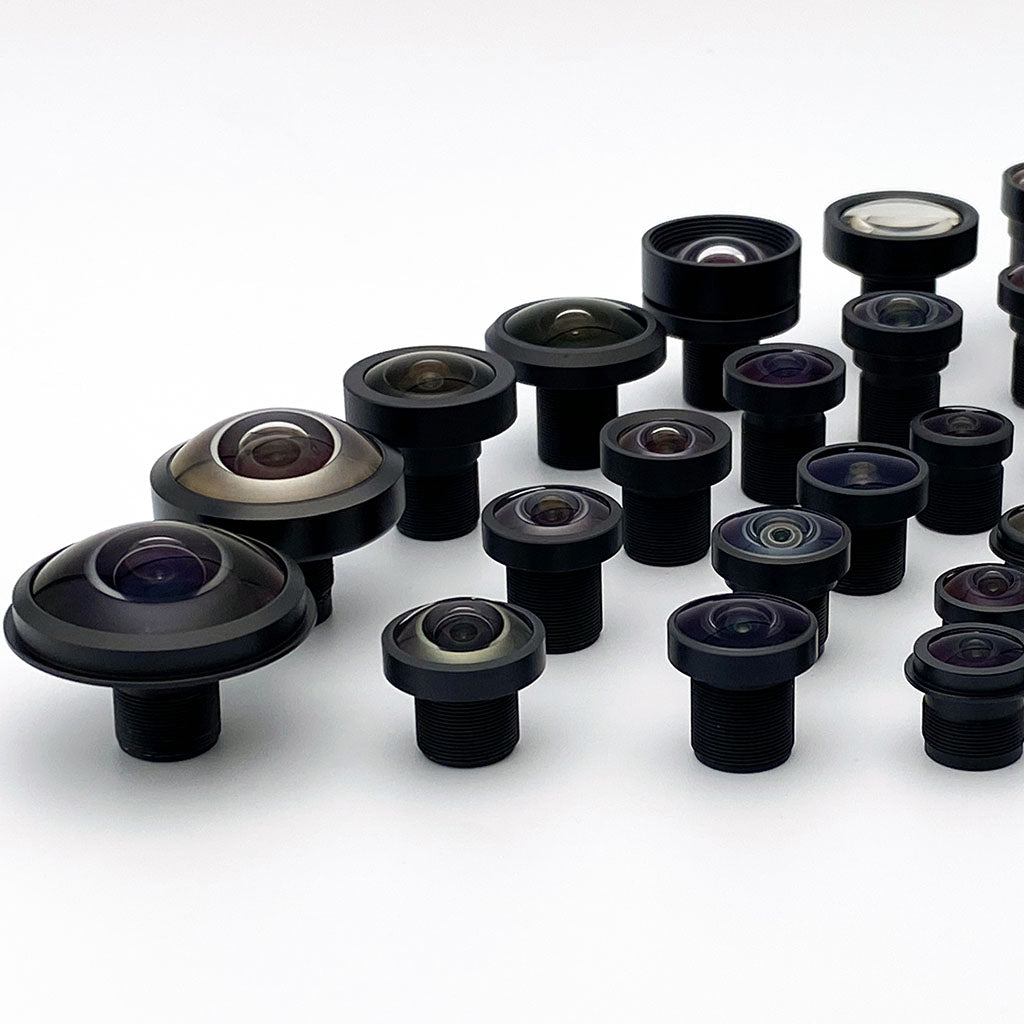
These are entocentric lenses, not telecentric ones. They fit when controlled fixturing, working distances long relative to part height, or a tolerance budget that absorbs residual perspective error means telecentricity is not required. Their distortion is specified rather than absent: the CIL034 holds under 1% on its display spec and the CIL062 measures −2% rectilinear. Those numbers govern in-plane accuracy after calibration, a separate property from magnification stability across depth.
The M12 vs. C-mount guide covers the mechanical differences between the two mount families. The choice turns on sensor format, working distance, and whether adjustable-iris depth-of-field control is needed, not on telecentricity.

Technical references
자주 묻는 질문
텔레센트릭 렌즈란 무엇인가요?
A telecentric lens is one whose chief rays, on at least one side of the system, run parallel to the optical axis instead of converging toward a finite point. The common object-space form places the entrance pupil at optical infinity, so apparent object size stays constant across the usable depth range.
물체-공간 텔레센트릭성이란 무엇인가요?
Object-space telecentricity means the entrance pupil sits at optical infinity on the object side. Chief rays from every field point travel parallel to the axis, so magnification stays much more constant as the object shifts slightly in depth. This is the form used for dimensional measurement.
이미지 공간 텔레센트릭성이란 무엇인가요?
Image-space telecentricity means the exit pupil sits at optical infinity on the image side, so chief rays arrive near-perpendicular to the sensor across the field. It improves coupling with sensor microlenses and can reduce corner shading, but it does not stabilize magnification versus object distance.
텔레센트릭 렌즈와 저왜곡 렌즈는 같은 것인가요?
No. Low distortion describes how faithfully a lens maps straight lines within a plane. Telecentricity describes chief-ray direction and whether magnification is stable versus depth. A lens can have very low distortion and still show perspective error. They correct different problems.
커먼랜즈에서 텔레센트릭 렌즈를 판매하나요?
아니요. 텔레센트릭 렌즈는 현재 Commonlands의 제품 라인업에 포함되어 있지 않습니다. 이 페이지는 교육용으로, 물체 공간 텔레센트릭성, 상 공간 텔레센트릭성 및 원근 오차에 대해 설명하여, 엔지니어들이 해당 응용 분야에 텔레센트릭 광학 부품이 정말로 필요한지, 아니면 표준 M12 렌즈 나 C-마운트 렌즈만으로도 측정 공차를 충족할 수 있는지 판단할 수 있도록 돕기 위한 것입니다.
검사 장비에 사용할 렌즈를 선택하고 계신가요?
텔레센트릭 광학 제품은 Commonlands의 제품이 아니지만, 표준 M12 및 C-마운트 렌즈만으로도 머신 비전 응용 분야의 대부분을 커버할 수 있습니다. 무료 계산기를 사용하여 작업 거리에 따른 시야각과 피사계 심도를 확인하거나, 엔지니어링 팀에 문의하여 구체적인 측정 공차에 대해 상담해 보시기 바랍니다.