
의료 영상용 렌즈: 마운트 선정, 센서 매칭 및 머신 비전 검사용 광학 시스템
Choosing a lens for a medical imaging camera or a medical device inspection line comes down to sensor geometry, mount class, and distortion tolerance. Inspection stations add a fourth factor: depth of field. This guide covers both threads with the same underlying optics.

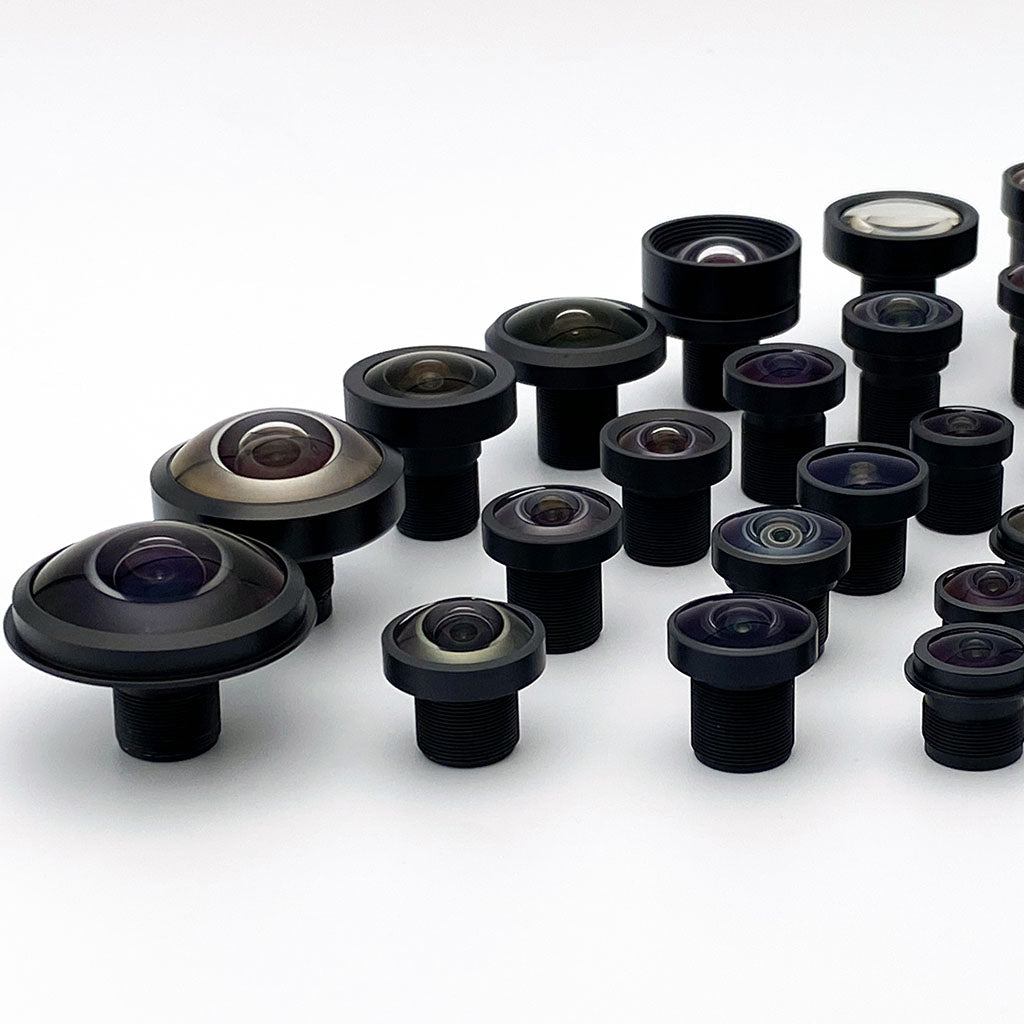
Medical imaging lens selection is a system-design problem, not a lens-catalog lookup. The right lens has an image circle that covers the required sensor area and a compatible CRA profile, fits the device package, and keeps distortion inside the software pipeline's tolerance. Use M8/M7 for extreme miniaturization, M12 for compact embedded modules (most models up to roughly 1/1.8 inch, select models to 2/3 inch), and C-mount for larger sensors or when an adjustable iris is needed for depth of field.
What Makes a Lens Suitable for a Medical Imaging Camera?
A suitable lens covers the required sensor area with acceptable illumination and sharpness, and matches its chief ray angle (CRA) requirements, the angle at which light from the lens meets the sensor at the frame edge. It also holds geometry within the software pipeline's distortion tolerance, responds correctly to the illumination wavelength, and fits the device package. Commonlands specifies image circle and distortion for every lens in this guide, so these geometry checks can start from published numbers.
These are stock catalog optics. They fit device development, prototyping, and non-diagnostic lab or inspection stations. Patient-contact optics, assemblies that face repeated sterilization, and lenses that carry regulatory qualification inside a finished device run through a custom development path instead.
A capsule endoscope module and a bench inspection instrument are different optical problems. A module with a 5-8mm diameter envelope needs optics designed to fit that complete package. M7 and M8 specify nominal thread diameters of 7mm and 8mm, before adding the holder wall. Check the lens and holder drawings rather than assuming either mount fits the envelope. For teams building high-stakes imaging workflows, the optical specification is a software reliability constraint, not just an image-quality preference.

Should I Use M8, M12, or C-mount for Medical Imaging?
Use M8 or M7 for development work at extreme miniaturization, the scale of capsule and catheter-tip modules, where diameter dominates every other constraint. Use M12 for compact embedded modules, where size, cost, and optical performance balance well. Most models cover sensors up to about 1/1.8 inch, with select models reaching 2/3 inch. Use C-mount when the sensor is larger or the instrument housing has the depth to accommodate the larger lens body. It is also the right choice when the system needs an adjustable iris for depth-of-field control.
| 마운트 | 일반적인 이미지 서클 | 패키지 | 아이리스 | 일반적인 센서 장착 방식 | 의료 영상 분야 |
|---|---|---|---|---|---|
| M8 / M7 | 최대 약 5mm–6mm | 초소형 | 수정됨 | 1/4인치 이하 | Development optics at endoscope-tip, capsule, and catheter scale |
| M12 | Up to ~9mm–11mm | 소형 임베디드 | 수정됨 | Up to 1/1.8" (select 2/3") | Compact embedded modules in device development, lab and inspection cameras |
| C-마운트 | 최대 ~20mm–22mm | 기기 / 작업대 | 조절 가능 | 최대 1.1인치 및 그 이상 | Bench lab instruments, larger-sensor imaging heads, microscopy ports |
The Commonlands M12 catalog spans 0.8mm to 100mm focal lengths. The picks below map the medical use cases to specific SKUs.
C-mount and M12 are different optical systems, not two sizes of the same design. An adjustable C-mount lens is focused by rotating its ring, but the standard dictates no mechanism behind that ring: designs move the whole cell, the front group, or internal groups on a cam, or omit adjustment entirely, and near-limit image behavior varies accordingly. Before a device bench layout locks in a close working distance, confirm those details on the datasheet or with Commonlands engineering.
A typical fixed-focal M12 assembly focuses by moving the whole lens on its thread. Other M12 designs, including varifocals, can move internal groups. Neither is a lesser version of the other. They trade in-barrel focus and iris control against size, weight, and simplicity.
How Do Focal Length, Sensor Size, and Image Circle Interact?
센서와 렌즈의 선정은 상호 의존적입니다. 한쪽을 먼저 결정하고 나중에 다른 쪽을 맞추는 방식은 설계 주기 후반부에 호환성 문제가 드러나게 하는 원인이 됩니다. 이미지 서클은 센서의 대각선 길이를 초과해야 하며, 초점 거리는 작업 거리와 필요한 시야각을 종합적으로 고려하여 결정되어야 합니다.
Nominal sensor format numbers (1/2", 1/1.7", 1/1.8") do not directly map to active-area dimensions. The active area has to be read from the sensor datasheet.
Do Medical Imaging Lenses Need Low Distortion, and Why Does CRA Matter?
Distortion and chief ray angle both have outsized effects on software pipelines relative to how visible they are on raw image inspection. Distortion is a direct source of measurement error in any pipeline that assumes rectilinear geometry. CRA mismatch causes corner shading and color non-uniformity that flat-field calibration cannot fully correct. Both should be specified explicitly before lens selection, not discovered during validation. Check the distortion convention and reference field height on each lens's data.
TV, rectilinear, and F-theta percentages describe different mappings and cannot be used interchangeably as an error bound.
Distortion places pixels at positions that do not match the correct rectilinear projection of the scene. Barrel distortion pulls edge pixels toward the center. Pincushion distortion pushes them outward. By the usual sign convention, negative distortion is barrel and positive is pincushion.
Chief ray angle is the angle at which the principal ray from the lens meets the sensor plane at a given image height. Small-pixel CMOS sensors shift each on-chip microlens laterally toward the array center, by an amount that grows with image height, so a chief ray arriving tilted still lands on the photodiode.
When the lens CRA departs from the profile the sensor was built for, the microlenses steer part of the cone away from the photodiode. The result is corner shading on monochrome sensors and color non-uniformity on color sensors, because the color filter channels are affected unevenly. Acceptance is not a single degree figure: it depends on the full cone (f-number), wavelength, pixel stack, and how much shading or MTF loss the pipeline tolerates.
When Are IR-Cut or NIR Filters Needed in Medical Imaging?
IR-cut filters are needed whenever the sensor responds beyond visible light and enough near-infrared energy reaches the scene to bias color. Halogen, incandescent, and ambient daylight carry significant NIR. Dedicated NIR LEDs do by design, but standard white LEDs emit little energy beyond 700nm. The IR-cut question is driven by the sensor's NIR response plus whatever NIR actually reaches the scene, not by an assumption that the illumination source itself is NIR-rich. Browse Commonlands optical filters for compatible options.
What Machine Vision Lens Should I Use for Medical Device Inspection?
Start with the inspection task, not the lens catalog. Assembly verification and UDI reading benefit from low distortion so geometry and code symbols read correctly across the field. Packaging and seal inspection create depth-of-field pressure from real package height variation, favoring an adjustable-iris C-mount lens. PCB inspection inside electronic medical devices shares both pressures. Dimensional metrology is the one case where telecentric optics may be justified. Most other tasks do not need them.
| 점검 업무 | 주요 광학적 요구 사항 | 기본 폼 팩터 | 아이리스 조절 기능이 유용할까요? |
|---|---|---|---|
| 조립 검증 (주사기, 바늘, 정맥 주입 용품) | 왜곡이 적고, 특징 배치 검사에 충분한 해상도를 갖추고 있음 | C-마운트 또는 M12 | Sometimes. Depends on assembly height variation |
| 포장 / 밀봉 검사 | 패키지 높이 변화에 따른 피사계 심도, 실링 경계면의 명암비 | C-마운트 | Yes. Adjustable iris for raised cavities or bead seals |
| UDI / 바코드 / 라벨 판독 | 심볼의 형상을 유지하기 위한 낮은 왜곡, 미세한 표시를 식별하기에 충분한 해상도 | M12 또는 C-마운트 | Less critical. Marks are typically on flat surfaces |
| PCB 검사 (전자 의료기기) | 기준점 및 기하학적 작업에 대한 왜곡, 부품이 실린 기판 높이를 초과하는 자유도(DOF) | C-마운트 | Yes. Component height variation benefits from iris control |
| 임플란트 표면/치수 계측 | 확대율 일관성, 낮은 왜곡 | 텔레센트릭(외부 공급업체) 또는 저왜곡 C-마운트 | Model-specific. Many commercial telecentric lenses do offer an adjustable iris |
Commonlands does not currently sell telecentric lenses. Specialist optics vendors supply them for the narrow set of tasks that genuinely require magnification constancy.
Top Lenses for Medical Imaging and Device Inspection by Use Case
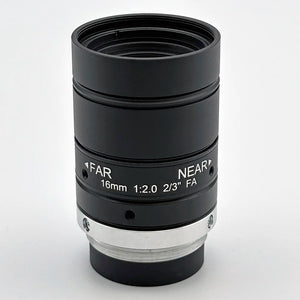
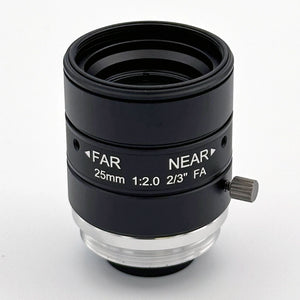
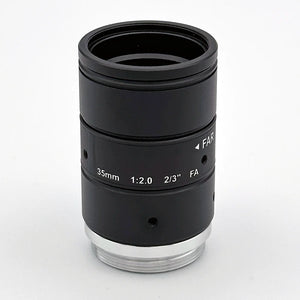
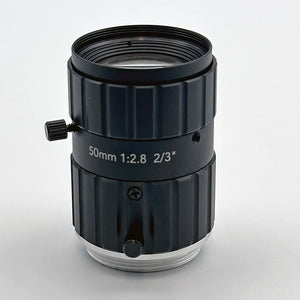
Match the lens to the job first, then the sensor. Miniature module development starts with the M8/M7 series, and compact embedded modules run on M12. Bench instruments or inspection stations that need an adjustable iris move to C-mount. The table maps Commonlands stock lenses to the use case each one fits, using the specs published on each product page. All ship same-day on orders placed before 12 PM PST.
| 사용 사례 | 렌즈 | 마운트 | EFL | 이 선수를 선택한 이유 |
|---|---|---|---|---|
| Miniature module development (endoscope and catheter scale) | M8 / M7 시리즈 | M8 / M7 | 단기, 고정 | Smallest diameter when the package dominates every other constraint. Fixed aperture and limited image circle. A development and prototyping starting point: tip geometry, biocompatibility, and sterilization push a finished device toward custom optics. |
| Compact embedded module (device development camera) | CIL085 | M12 | 8.2mm | 1/1.8" coverage, 57° FOV, -0.9% distortion, 8.9mm image circle. Mid-FOV workhorse for an embedded module. On a 1/1.7" sensor (~9.4mm diagonal), the corners fall outside the rated circle, so verify corner performance or step up to a larger-circle lens. |
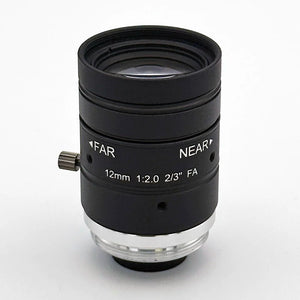
| Bench instrument optics (longer working distance) | CIL121 | M12 | 21.8mm | 500mm 작업 거리에 맞춰 보정된 유한 공액 M12 렌즈로, 장공액 렌즈가 선명도가 떨어지는 기구 사용 범위에서도 모서리 부분의 선명도가 유지됩니다. |
| 기기/카트 기반 이미징 (컴팩트 C-마운트) | CIL561 | C-마운트 | 6mm | 1/1.7인치, 76° 시야각, -2% 왜곡, 벤치 헤드에 장착되어 피사계 심도 조절이 가능한 F/2.4 조절식 조리개. |
| 기기/카트 기반 영상 촬영 (고해상도) | CIL544 | C-마운트 | 25mm | 1.1인치, 20MP급 화각, 17.6mm 이미지 서클, 대형 센서 이미징 헤드용 130mm~무한대 WD. |
| 기기 검사 / UDI 판독 | CIL052 | M12 | 5.2mm | -0.1%의 왜곡률로 F/3.4에서 최대 1/1.8"까지 전체 화각에 걸쳐 데이터 매트릭스 및 바코드의 기하학적 형태를 유지합니다. |
| Washdown-line inspection (sealed) | CIL059 | M12 | 5.9mm | IP67-sealed variant: dust-tight and tested to 1 meter immersion for 30 minutes under IEC 60529, for the tested variant in its mounted configuration. That rating covers water and dust only. It says nothing about disinfectant compatibility, repeated wiping, sterilization, biocompatibility, or the assembled device. F/1.7 to F/5.6 selectable at procurement. About -4% distortion suits contrast-based checks, not geometry-critical reads. |
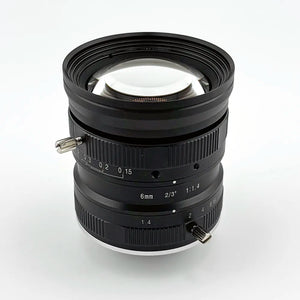
| 포장 / PCB 검사 (피사계 심도) | CIL522 | C-마운트 | 12mm | F/1.4에서 F/16까지 조절 가능한 조리개, 0.4%의 왜곡, 11.4mm의 화각. 패키지 높이 차이에 따른 피사계 심도를 확보하려면 조리개를 조이십시오. |
These stock lenses fit prototyping, bench and lab instruments, and inline inspection stations, where the optic sits behind a window or housing and never touches the patient. Patient-contact optics, lenses that have to survive repeated sterilization cycles (autoclave, EtO, gamma), and any lens that must carry regulatory qualification inside a finished device all need a custom development path. A catalog part will not cover them. If that is your case, send the requirement to engineering for a custom quote.


자주 묻는 질문
의료용 영상 촬영 렌즈란 무엇인가요?
Medical imaging lenses serve diagnostic imaging, device development, and laboratory work. This guide discusses stock-lens candidates for development and inspection, without establishing qualification for diagnostic use. Select by sensor coverage, angular response, distortion, wavelength band, mechanical fit, and environmental requirements. Validate the complete imaging system for the intended task.
의료 기기용 카메라에 사용할 렌즈는 어떻게 선택해야 하나요?
Define six parameters before evaluating any lens: required field of view and working distance, sensor format and pixel pitch, the package constraint that sets mount class, the distortion tolerance the software pipeline requires, the CRA budget the sensor imposes, and the wavelength stack the illumination uses. Sensor and lens should be selected together. Choosing a lens first and fitting the sensor afterward tends to produce re-spins.
의료용 영상 촬영에는 M8, M12, 아니면 C-마운트 중 어떤 것을 사용해야 할까요?
Use M8 or M7 for development work at extreme miniaturization, the scale of capsule and catheter-tip modules. Use M12 for compact embedded modules. Most models cover sensors up to about 1/1.8 inch, with select models reaching 2/3 inch. Use C-mount when the sensor is larger or the instrument housing has room for the larger lens body. It is also the right choice when the system needs an adjustable iris for depth-of-field control.
의료 영상 분야에서 IR-cut 필터나 기타 광학 필터는 언제 필요한가?
IR-cut filters are needed whenever the sensor responds beyond visible light and enough near-infrared energy reaches the scene to bias color. Halogen, incandescent, and ambient daylight all carry significant NIR. Dedicated NIR LEDs carry it by design too, though standard white LEDs emit little energy beyond 700nm. The IR-cut question is driven by the sensor's NIR response plus whatever NIR actually reaches the scene. NIR-pass or narrow-band filters are needed instead when the application specifically images in the near-infrared or fluorescence-adjacent bands. Browse optical filters for compatible options.
의료 기기 검사에 어떤 머신 비전 렌즈를 사용해야 할까요?
Start with the inspection task, not the lens catalog. Assembly verification and UDI reading benefit from low distortion. Packaging and seal inspection create depth-of-field pressure from package height variation, favoring an adjustable-iris C-mount lens. PCB inspection inside electronic medical devices shares both requirements. Dimensional metrology is the one case where telecentric optics may be justified, since most other tasks do not need them. Commonlands options include the CIL052 (5.2mm M12, -0.1% distortion), CIL059 (5.9mm M12, IP67 variant), CIL522 (12mm C-mount, adjustable iris), and CIL544 (25mm C-mount, 20MP+ coverage).
팀은 렌즈를 양산 단계로 확정하기 전에 무엇을 검증해야 할까요?
실제 작동 거리에서 센서 전체에 걸친 화질(해상도, 왜곡, 음영, 색상 정확도), 특정 센서와의 CRA 호환성, 작동 온도 범위 전반에 걸친 초점 안정성, 기기가 임상 표면에 접촉할 경우의 오염 저항성, 현장 환경에서의 기계적 신뢰성, 그리고 렌즈와 센서의 정렬에 대한 제조 가능성을 검증해야 합니다. 모든 점검 시 대체품이 아닌 실제 센서와 조명 소스를 사용해야 합니다.
Have a Sensor and Working Distance in Hand?
Commonlands는 의료용 이미징 카메라 및 의료 기기 검사 스테이션용 M12 및 C-마운트 렌즈를 제조하며, 일부 렌즈에 대해서는 공개된 왜곡 사양 및 MTF 테스트 데이터를 확인할 수 있습니다. ISO 9001:2015 인증을 획득했습니다. 태평양 표준시(PST) 기준 오후 12시 이전에 주문하신 경우, 샘플은 당일 발송됩니다.