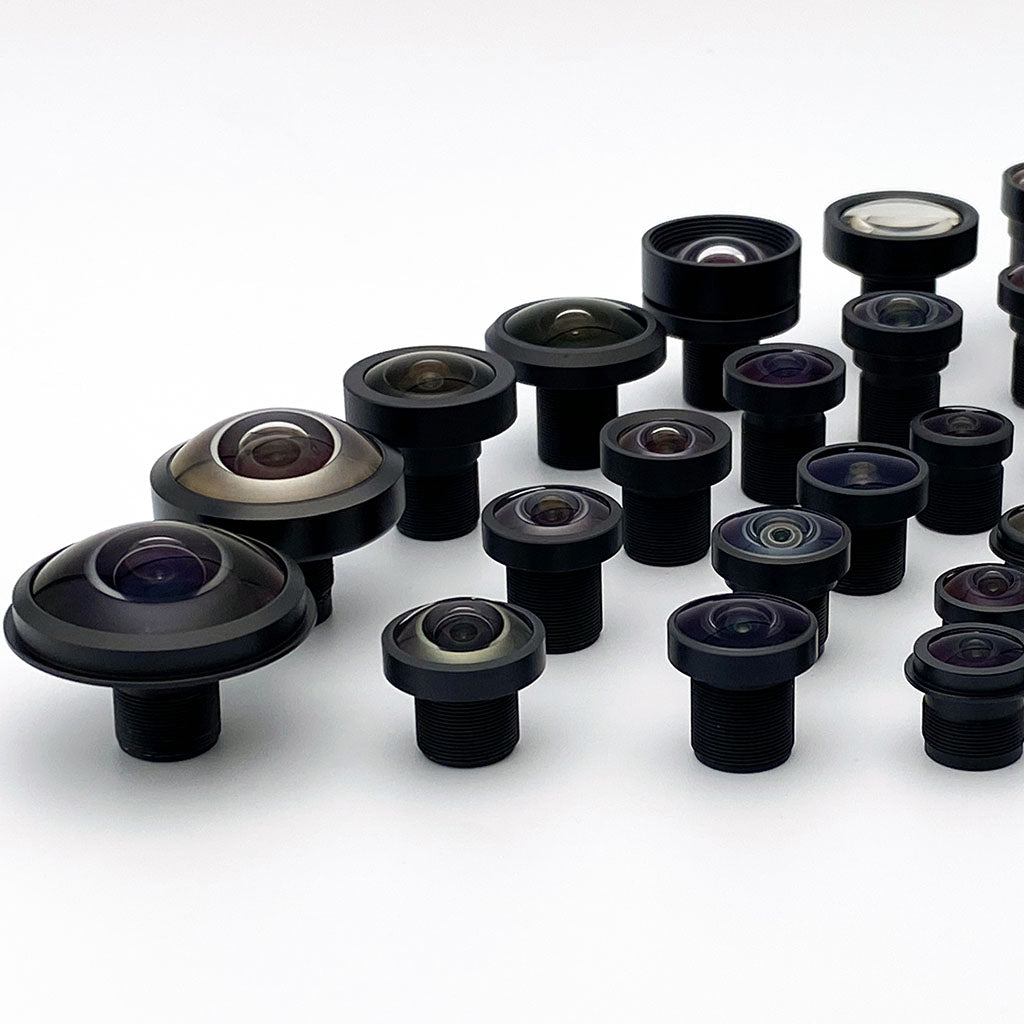

머신 비전 렌즈의 IP 등급: IP67, IP68, IP69K가 실제로 의미하는 바
IEC 60529 and ISO 20653 define dust and water protection for lens barrels. This guide covers how a sealed M12 barrel earns its rating and which Commonlands SKUs carry a verified one.

IP ratings for machine vision lenses follow IEC 60529. The first digit covers solids: 6 means dust-tight. The second digit covers liquids: 7 means immersion to 1 meter for 30 minutes, and 8 means immersion beyond those conditions at a depth and duration the manufacturer specifies. IP6K9K (industry shorthand IP69K), tested under the separate ISO 20653 standard, certifies that a sealed lens variant passed a hot liquid-water jet in a prescribed mounting configuration. The jet is not steam, not detergent, and not a sanitation cycle.
A sealed M12 lens gets its rating from O-rings at the thread interface and sealed internal barrel joints, not from the glass itself. The rating applies to a specific mechanical variant, not the whole SKU family. The Commonlands CIL034 M12A is IP67, but the CIL034 M12B has no ingress rating at all. Each rating covers that variant as mounted, not the camera behind it.
What Do the IP Rating Digits Actually Mean?
An IP code is two digits after the letters "IP," defined in IEC 60529, Degrees of Protection Provided by Enclosures. The first digit, 0 through 6, rates protection against solids: a 6 means dust-tight.
The second digit, 0 through 9, rates protection against liquids. A 7 means immersion in still water to 1 meter for 30 minutes. An 8 means immersion beyond that, at a depth and duration the manufacturer specifies. A 9 is not immersion at all: it is a close-range jet at roughly 80°C and 80 to 100 bar, sprayed from 100 to 150mm at several angles.
Inside an IEC 60529 code, that jet test is written IPX9. ISO 20653 specifies its own version of the same jet test, written IP6K9K in full or IPX9K for the water test alone; IP69K is the industry shorthand. Read them as two separate marks: a datasheet claiming IP69K should cite ISO 20653, not IEC 60529.
Because the tests load the seals differently, the two ratings are not points on one scale. An IP67 mark does not certify performance against a high-pressure jet, and an IP6K9K mark does not imply the 30-minute immersion test was run. The second digit is not a ladder: IPX7 is tested by immersion alone, so it is not a pass of the IPX3 rain, IPX4 splash, IPX5 or IPX6 jet tests. Assume any digit the datasheet omits was not run, and read a dual-marked part as two tests passed.
Commonlands seals select M12 lens variants to IP67 and IP69K. Each rating below belongs to a tested variant in its mounted configuration, not to a bare barrel on a bench.
| 평점 | 첫 번째 자리수 (실수) | 두 번째 자리 (액체) | 대표적인 적용 사례 |
|---|---|---|---|
| IP65 | 방진 | 6.3mm 노즐에서 모든 방향으로 물줄기가 분사됩니다. | 실내 세척 구역, 약간의 물 튀김 |
| IP67 | 방진 | 수심 1m에서 30분간 잠수 | Typical first candidate for outdoor and delivery-robot builds; immersion-only test, so qualify the installed assembly |
| IP68 | 방진 | IPX7 등급을 초과하는 수중 노출, 제조사가 지정한 수심 및 노출 시간 | 수중 검사, 수중용 하우징 |
| IP69K | 방진 | High-pressure, high-temperature jet (ISO 20653, ~80°C, 80–100 bar, 100–150mm) | Automotive underbody and ADAS, high-pressure hot-water washdown areas |

IP67 vs IP69K: Which One Does Your Application Need?
The decision comes down to one question: does routine operation include a close-range high-pressure hot-water jet? If yes, specify a variant tested to IP6K9K. For rain and splash, teams usually shortlist the sealed IP67 variant first, then qualify the installed camera under its real wetting, because only immersion is tested.
Reading immersion across to rain is engineering judgment about the seal, not a certified result: IPX7 is an immersion test and nothing else. Neither rating covers steam, detergents, or sanitation cycles, and condensation inside a sealed camera is a humidity and thermal-cycling problem no IP digit answers.
Where an IP67 Variant Is the Usual Starting Point
- Outdoor security and monitoring cameras exposed to rain and wind-driven spray
- 관개 분무 및 밭의 습도에 영향을 받는 농업 모니터링 시스템
- Delivery robots, outdoor mobile robots, and drone camera payloads
- Outdoor industrial installations with rain or splash, not directed pressure
Where IP69K Testing Applies
- Automotive ADAS cameras in wheel-well, underbody, or engine-bay positions exposed to road spray and pressure-wash jets rather than a full commercial wash cycle (see lenses for autonomous vehicles)
- Food and beverage lines under manual high-pressure hot-water washdown; clean-in-place chemistry and sanitizer contact are separate compatibility questions
- Pharmaceutical washdown areas (steam sterilization/autoclave at 121–134°C is a separate qualification that IP69K does not certify)
- 고압 물을 이용해 세척한 광산 및 건설 장비
Some wash systems approach or exceed the 80°C and 80–100 bar conditions of the IP6K9K test. Confirm your actual pressure and temperature against ISO 20653 before assuming IP6K9K covers the cycle, and talk to Commonlands engineering.
Specifying above the requirement costs money and lead time. An IP6K9K seal stack is more involved than the IP67 build in the same family, and buys nothing if the camera only sees rain. The reverse error is worse: an IP67 seal hit by a directional 80°C jet at close range can fail where rain never troubled it.
How Is an M12 Lens Barrel Sealed to Reach an IP Rating?
An M12 lens has three predictable entry points for dust and moisture in an unsealed design: the M12×0.5 thread interface at the camera mount, the joints between internal barrel sections, and the retaining ring that holds the front element. A sealed variant closes each path mechanically.
- Thread interface O-ring. An O-ring at the M12 thread, compressed when the lens is torqued into the mount, blocks the threads, the single largest gap in an unsealed design.
- Sealed internal barrel joints. Where the barrel is assembled from multiple machined sections, adhesive or press-fit seals close the seams so moisture cannot migrate between elements.
- 전면 렌즈 요소가 접착되거나 밀봉 처리되어 있습니다. 드라이 핏 방식의 탈착식 고정 링 대신, 전면 표면이 접착되거나 개스킷으로 밀봉되어 있어 가장 노출된 광학 표면이 물과 직접 접촉하지 않도록 차단합니다.
- Hydrophobic front coating (optional). It makes water bead and roll off the front element, which reduces contamination and improves contrast in rain. It is a surface treatment, not an ingress seal.
Two mechanical facts follow. First, sealing is baked into a specific mechanical variant, which is why the same base SKU can ship sealed and unsealed. Second, on these barrels the seal is set at assembly, so a unit does not move from unsealed to IP67, or IP67 to IP6K9K, in the field. Neither standard forbids a resealable design; that is a product-design question, not something the IP code decides.
The step from IP67 to IP6K9K is not a stronger version of the same O-ring. A close-range directional jet can exploit a gap that slow immersion never loads hard enough to reveal. ISO 20653 specifies the exposure and the pass criterion, not a construction. The Commonlands barrels that pass it run higher O-ring compression and add sealing at the barrel-to-cap interface. An automotive-grade variant such as the CIL190 adds an all-glass formula in an aluminum barrel rather than unfilled-plastic components.
Metal is favored here less for thermal expansion than for creep: an unfilled polymer barrel deforms slowly under sustained O-ring load at washdown temperature, relaxing the seal squeeze.
Why Does the Same SKU Sometimes Carry Different IP Ratings?
Commonlands lists mechanical variants under one base part number: the optics are identical and only the barrel construction differs. The variant suffix, not the base SKU, determines the ingress rating.
The clearest example is the CIL034, a 3.2mm wide-angle M12 lens. The M12A variant is IP67 sealed with a thread-interface O-ring. The M12B variant has no ingress rating. Both share the same optics: 3.2mm EFL, 102° field, 8.0mm image circle. "CIL034" without the variant suffix does not tell a BOM reviewer whether the part is sealed.
| SKU | 변형 | 침투 등급 |
|---|---|---|
| CIL034 | M12A | IP67 |
| CIL034 | M12B | 방수 등급 없음 |
| CIL059 | M12A | 방수 등급 없음 |
| CIL059 | M12B | IP67 |
Always confirm the full part number, including the variant suffix, against the current product page or an engineering quote before assuming a unit is sealed. CIL034-F2.7-M12A660 is the sealed IP67 build; CIL034-F2.7-M12BNIR is the unsealed M12B of the same optics.
Does a Sealed Lens Replace an External Camera Housing?
Only if the rest of the camera is sealed too. A sealed barrel closes the optical path, but the camera board, connectors, and enclosure behind the lens are separate systems with their own ingress paths.
Two integration patterns are common. In the first, a sealed lens threads into a camera module whose board and connectors are sealed to a matching rating. That opens the option of removing the separate housing, its window, and the window's reflection loss; removal is an architecture decision, not an automatic consequence of matched ratings, so validate the installed assembly against the actual exposure.
In the second, an unsealed camera goes into an external IP-rated enclosure with a window in front of a standard lens. It fits any camera but adds weight, bulk, and a window to maintain. Specified early, the sealed path is usually cheaper.
| 요인 | 밀폐형 렌즈 + 밀폐형 카메라 모듈 | 표준 렌즈 + 외부 하우징 |
|---|---|---|
| 추가 광학 표면 | 없음 | Protective window, ~4% reflection per surface uncoated (~8% total); <1% per surface AR-coated |
| 추가 중량 | 렌즈 무게만 | 크기, 재질 및 창에 따라 달라지는 인클로저 무게를 추가했습니다. |
| 개조 유연성 | 낮음 (설계 시 지정) | 높음 (대부분의 기존 카메라에 호환됨) |
| 구매 후 IP 업그레이드 | Not offered on these barrels | 인클로저 교체 |
| 창문 관리 | 해당 없음 | 필수 (안개 현상, 긁힘, 세척 시 접근성) |
For background on M12 construction and mount standards, see what is an M12 lens. For environmental design beyond ingress (thermal stability, vibration resistance, and coatings), see ruggedized machine vision lenses.
Top IP67 and IP69K M12 Lenses
Commonlands sealed M12 lenses fall into two ingress classes. IP6K9K variants are tested against the ISO 20653 hot-water jet, the exposure behind automotive and food-line pressure washing. IP67 variants are tested by immersion; for rain and irrigation exposure they are a first-pass shortlist, and the installed camera still has to prove itself against real spray. Each rating below is tied to a specific mechanical variant, not to the base SKU.
Every rating below was checked against live Commonlands product data on 2026-07-25 and listed by mechanical variant, because the base SKU alone does not determine sealing. Ranking within each class reflects deployment fit, not optical quality.
| 순위 | 렌즈 (변형) | EFL과 조리개 | 검증된 IP 등급 | 최적의 적용 사례 | 상품 페이지 |
|---|---|---|---|---|---|
| 1 | CIL190 M12A | 19mm, F/1.6 | IP69K | ADAS 및 로봇 세차용 20° 좁은 시야각; 전면 유리 및 전면 금속 배럴 | CIL190 19mm IP69K M12 렌즈 |
| 2 | CIL384 M12A | 3.34mm, F/1.6 | IP69K | 고속 광각 자동차 전면 및 서라운드 카메라; 116° 화각 | CIL384 자동차용 IP69K M12 렌즈 |
| 3 | CIL034 M12A | 3.2mm, F/2.7 | IP67 | Wide-angle shortlist pick where rain and splash, not directed pressure, are the expected exposure; 102° field | CIL034 IP67 저왜곡 M12 렌즈 |
| 4 | CIL215 M12A | 1.5mm, F/2.0 | IP67 | 190° IR-corrected fisheye to evaluate for day and night outdoor coverage | CIL215 190° 적외선 보정 피쉬아이 M12 렌즈 |
| 5 | CIL059 M12B | 5.9mm, F/1.7 | IP67 | Standard 76° field, a common starting option for outdoor and agricultural cameras; fast aperture for low light | CIL059 6mm IP67 M12 렌즈 |
IP69K here is shorthand for the ISO 20653 IP6K9K jet rating. None of these ratings extend to other Commonlands lenses or to a different variant of the same lens, and an IP rating on the barrel does not seal the connector or cable exit behind it.

자주 묻는 질문
머신 비전 렌즈에서 IP67은 무엇을 의미하나요?
Under IEC 60529, the first digit of IP67 means the lens barrel is dust-tight. The second digit means immersion in still water to 1 meter for up to 30 minutes, on the lens variant in the mounting configuration tested. That is the whole exposure. Reading it across to rain and splash is engineering judgment, not a test result: IPX7 is immersion alone, so the mark does not pass the separate IPX3, IPX4, IPX5, or IPX6 spray and jet tests.
렌즈의 경우 IP67과 IP69K의 차이점은 무엇인가요?
IP67 is tested under IEC 60529 as immersion to 1 meter for 30 minutes, a slow hydrostatic load. IP6K9K (industry shorthand IP69K) is tested under ISO 20653 as a high-pressure, high-temperature water jet at roughly 80°C and 80 to 100 bar from close range. A lens can pass one test and fail the other because the seals experience a completely different mechanical stress in each case.
CIL034 렌즈의 IP67 등급은 해당 렌즈의 모든 버전에 적용되나요?
No. The Commonlands CIL034 ships in two mechanical variants. The M12A variant is IP67 sealed with an O-ring at the thread interface. The M12B variant carries no ingress rating at all. Always check the specific part number suffix, not just the base SKU, before specifying a sealed lens.
M12 렌즈 배럴은 IP 등급을 충족하기 위해 어떻게 밀봉되나요?
Sealed M12 lenses use an O-ring at the M12 thread interface, adhesive or press-fit seals between internal barrel sections, and in many designs a bonded or sealed front element rather than a removable retaining ring. Some variants add a hydrophobic coating on the front surface to shed water, which reduces contamination but is not itself an ingress seal. The rating is measured on the lens mounted that way, not on a loose barrel.
제 용도에 IP67 등급이 필요한가요, 아니면 IP69K 등급이 필요한가요?
For rain, irrigation spray, and outdoor exposure, a sealed IP67 variant is where evaluation usually starts, not a certified answer: IP67 covers dust-tightness and temporary immersion only, so qualify the installed camera under the conditions your site actually produces. For close-range high-pressure hot-water exposure, such as automotive underbody positions or food-line washdown, specify IP6K9K (industry shorthand IP69K) variants tested under ISO 20653, and confirm your wash pressure and temperature against that test.
밀폐형 렌즈를 사용하면 카메라 하우징이 필요 없게 되나요?
A sealed lens protects the barrel itself. When the camera body and sensor board are sealed to a matching or higher rating, omitting the external housing becomes an architecture option, provided you validate the full installed assembly against the actual exposure it will see. If the camera body is not sealed, it still needs protection independently of the lens rating.
Need Help Specifying the Right Ingress Rating?
Send Commonlands engineering the deployment environment (rain exposure, washdown cycles, and temperature range) and get a sealed lens recommendation with the correct mechanical variant.