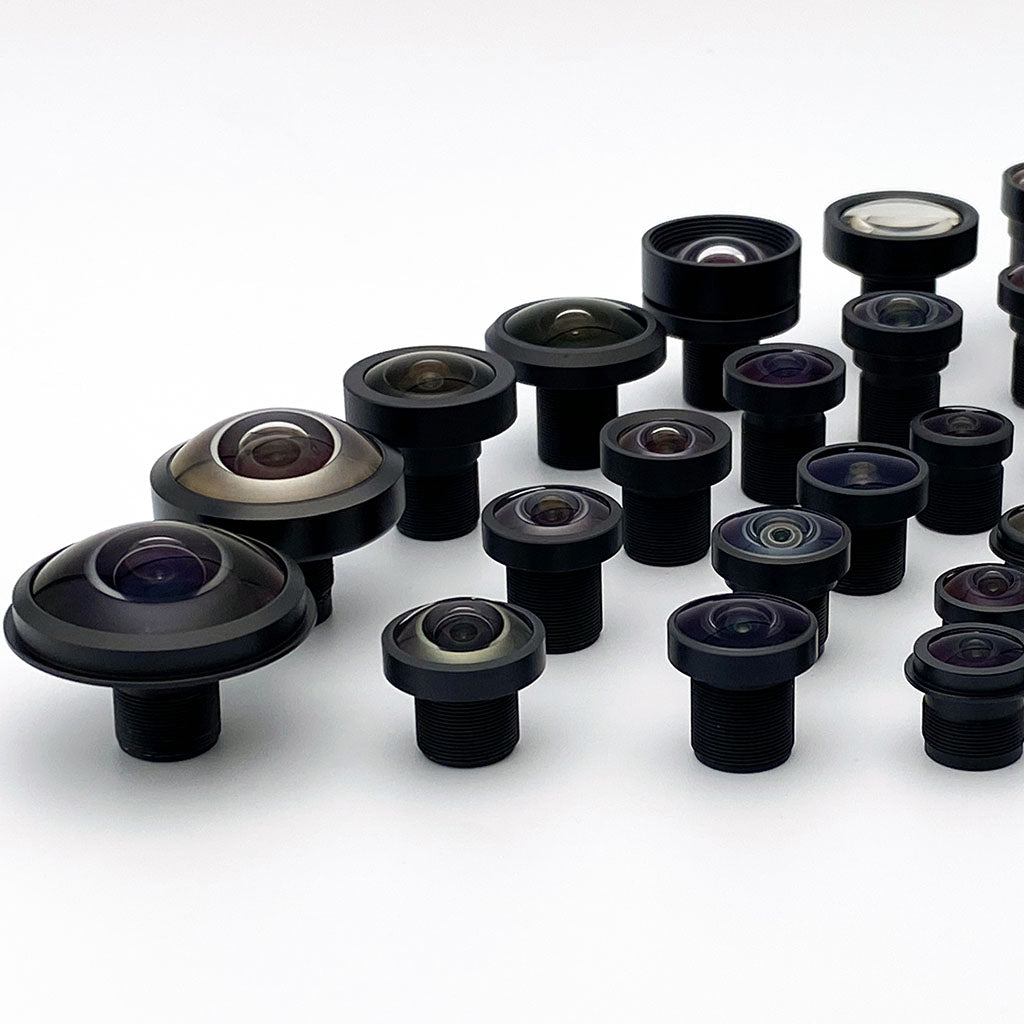

머신 비전용 IR 보정 렌즈: 가시광선 및 근적외선 조명 조건에서의 초점 안정성
Most standard lenses defocus under 850nm or 940nm illumination because their correction stops at the visible band. This guide separates chromatic focus shift from the thermal and filter-induced kinds, then shows which Commonlands M12 lenses hold focus across both.

An IR corrected lens extends chromatic focus correction into the near-infrared band, typically 850nm and 940nm, so visible and NIR light share one focal plane within the system's depth of focus. Most standard lenses are corrected across the visible band only, so they defocus when illumination switches to NIR, a wavelength-dependent case of focus shift called longitudinal chromatic aberration.
Removing an IR-cut filter does not fix this. The filter only selects which wavelengths reach the sensor. It does nothing to close the lens's visible-to-NIR focus separation. Simultaneous RGB/NIR capture needs adequate common-focus performance across both bands. A day/night camera can instead refocus between bands or use a filter design that compensates for the remaining focus shift.
IR 보정 렌즈란 무엇인가요?
An IR corrected lens is a lens whose optical design extends chromatic focus correction beyond the visible band into the near-infrared, typically holding the visible-to-NIR focus separation from 400nm through 850nm or 940nm inside the system's depth of focus, not driving it to zero. Most standard lenses are corrected across the visible band only and defocus under NIR when they were focused in visible light. Some ordinary designs do hold part of the NIR band. Only measured through-focus data at your wavelengths tells you which you have.
The bench test is direct: focus under visible light, switch to NIR without touching focus, and capture at the production aperture. Sharpness there is evidence, not proof, since stopping down hides a large shift. Measure best-focus separation between the two wavelengths, or through-focus MTF at each.
Correction is a matter of degree. An ordinary multi-element prescription already narrows the visible-to-NIR gap while achromatizing the visible band. Designs that target NIR narrow it further through element count and glass selection, and datasheets specify the wavelength range where focus holds. For the aberration family this addresses, see lens aberrations in machine vision.
광학 설계를 통해 적외선 보정이 이루어지는 방식
A single lens element cannot hold visible and NIR light at the same focal plane, because every glass type has its own dispersion curve, the relationship between refractive index and wavelength. IR correction pairs element materials with complementary dispersion so the combined system brings a wider wavelength range to a common focus than any single glass could. It is the achromatic doublet principle, extended to include 850nm and 940nm.
Dispersion curves are nonlinear and glass catalogs are finite, so a designer accepts a residual visible/NIR offset rather than eliminating it. A well-corrected lens holds that offset within the system's depth of focus at the intended aperture and format. Ask for the number rather than the label: maximum focus shift or MTF loss across wavelength, field, aperture, temperature, and conjugate, against the depth of focus you have.

초점 이동이란 무엇이며, 왜 파장이 이를 유발하는가?
Focus shift is the movement of the plane of best focus after an optical condition changes, even though no one touched the mechanical focus setting. It is distinct from back-focus error, a static lens-to-sensor misalignment set once at assembly.
Three mechanisms move the focal plane, each with its own fix. A fourth condition, aperture, mainly changes how much shift the system tolerates rather than where the plane sits, although residual spherical aberration can shift best focus as the aperture changes. Wavelength is the chromatic case this pillar covers: glass refractive index varies with wavelength, so 850nm or 940nm NIR converges at a different axial distance than visible light. In a non-IR-corrected lens, that separation can be large relative to the sensor's depth of focus.
| Condition that changes | 무엇이 움직이는가 | 전형적인 증상 | 실용적인 해결책 |
|---|---|---|---|
| 파장 변화 (가시광선 → 근적외선) | 색상별 초점면 분리 | Blur in one illumination mode. Day/night performance gap | IR 보정 렌즈 |
| 필터 또는 스위처가 장착됨 | 광경로 길이가 증가한다 | Defocus when filter is in. Varies between filter states | Compensated filter switcher. Back-focus re-set with filter in place |
| 기온 상승 또는 하락 | 열에 의한 초점면 드리프트 | 극한 온도에서는 초점 성능이 저하됩니다 | All-glass lens. Athermalized design (see ruggedized guide) |
| 조리개 변경 (조리개 조이기) | 피사계 심도 범위가 넓어진다 | 조리개를 조이면 더 선명해 보입니다(시프트 현상을 가려줄 뿐, 해결해 주지는 않습니다). | 생산 개구부에서 진단 |
The longitudinal chromatic aberration behind this focus shift differs from lateral chromatic aberration, which spreads color fringing across the field rather than moving the axial focal plane. IR correction targets the longitudinal component.
Filter-stack shift is a separate, predictable effect
Inserting a plane-parallel glass plate into a converging beam shifts the paraxial focus away from the lens. A sensor cover glass or rear filter can produce this shift. The following approximation assumes near-normal incidence and air on both sides of the plate.
A 340μm shift can exceed the focus tolerance of a fast lens. Compare each filter state using t(1-1/n), rather than optical path length nt. Matching this focus displacement preserves the plate contribution when filters switch. Deliberately different displacements can compensate residual lens chromatic shift. Verify the complete lens, filter, and sensor assembly at both wavelengths.
The Commonlands CLA216-ICR-850BP compensates this: its glass thickness offset between the 650nm IR-cut and 850nm bandpass sides matches the two path lengths, so one focus setting stays valid across both.
IR 보정 렌즈가 표준 렌즈 및 IR 차단 필터를 제거한 렌즈와 어떻게 다른지
These three things are often conflated. A standard lens with an IR-cut filter gives a sharp visible image because the filter stops out-of-focus NIR light from reaching the sensor, not because the lens itself is corrected. Remove that filter and NIR light gets through, but the optics still carry the same chromatic focus shift, so the NIR contribution is now visible and out of focus relative to the visible-light setting.
Commonlands labels the no-filter build NIR-pass (SKU suffix ANIR): the filter slot is empty, so visible and NIR both reach the sensor. This is not a NIR-pass longpass filter: visible light still gets through, and the band that reaches the sensor is set by the glass, coatings, and sensor QE, not by a defined passband.
An IR corrected lens in that NIR-pass build holds focus from visible through NIR in the optics, so no refocus is needed when illumination switches. Commonlands IR-corrected M12 lenses ship in both a 650nm IRC build (daytime visible) and this NIR-pass build (RGBIR and day/night).
| 렌즈 및 필터 구성 | 최적의 활용 사례 | 주요 위험 |
|---|---|---|
| 표준 렌즈 + IR 차단 필터 | 가시광선 전용 이미징, 근적외선(NIR) 조명 없음 | IR-cut blocks NIR. Cannot use 850/940nm illumination |
| 표준 렌즈, IR 차단 필터 제거 | 협대역 근적외선(NIR) 전용이며, 해당 파장에 맞춰 초점을 재조정함 | Visible and NIR focus at different positions. Dual-wavelength use needs refocus |
| IR 보정 렌즈 + 650nm IRC | 주간 가시광선 촬영 가능, 향후 근적외선(NIR) 촬영 기능 도입 가능 | 듀얼 밴드 사용을 위해서는 NIR 투과형 모델로 교체해야 합니다. |
| IR 보정 렌즈, NIR 투과형 (필터 없음) | RGBIR 카메라, 주야간 전환 기능, 순수 850/940nm 시스템 | 고해상도에서도 잔류 가시광선/근적외선(VIS/NIR) 편차가 여전히 중요할 수 있다 |
RGBIR 및 주야간 시스템에서 적외선 보정은 언제 중요한가요?
IR correction is not necessary in every application. A visible-only system with an IR-cut filter has no need for it. The cases where it becomes a design requirement share one factor: the system must produce a sharp image at two or more wavelengths from the same focus position.
RGBIR 센서
RGBIR sensors capture RGB and NIR-sensitive pixels through the same lens at one focus distance. A lens with significant chromatic focus shift leaves the NIR channel softer than the RGB channels, most visibly on high-resolution sensors with small pixel pitch.
Where the channels come off one exposure, the common case, there is no chance to refocus between them, so the lens must hold both wavelengths at once. Some sensors and drivers instead use channel-dependent gain, staggered or multiplexed exposures, or separate processing paths, so read the datasheet before assuming.
주간/야간용 카메라
A day/night camera uses visible illumination in daylight and 850nm or 940nm LED illumination at night. Without an IR-corrected lens, a fixed-focus camera is sharp in one mode and soft in the other, since it has no motorized refocus on mode change. It can pass a daytime acceptance test, then image softly the moment NIR illumination activates, so validate focus under both modes before deployment.
Decide the IR-correction requirement before choosing a focal length or mount. It turns on one question: must the system stay sharp at two wavelengths from a single focus position? Confirm the destination format with sensor size and lens compatibility, since residual shift bites hardest on small, high-resolution formats.
주간/야간 머신 비전용 최고의 IR 보정 M12 렌즈
The three lenses below are candidates for visible/NIR systems. Confirm the residual focus shift at your wavelengths, aperture, working distance, and temperature. An unfiltered NIR-pass variant transmits NIR but does not, by itself, establish common visible/NIR focus.
Commonlands ranked these three by how broadly each covers day/night and RGBIR work: focus held across visible and NIR, image circle against common 1/2" and 1/1.8" formats, and a fast fixed F/2.0 aperture for 850/940nm LED scenes. To match a focal length to your sensor, run the lens field of view calculator.
| 순위 | 렌즈 | EFL | F# | 이미지 서클 | 다음에 가장 적합합니다 |
|---|---|---|---|---|---|
| 1 | CIL046 | 4.4mm | F/2.0 | 8.9mm | Wide 100° field for RGBIR and day/night sensors up to 8MP |
| 2 | CIL122 | 12mm | F/2.0 | 9.3mm | Narrower 43° field for day/night and robotics on 1/1.8" 8-12MP sensors |
| 3 | CIL161 | 15.6mm (nominal 16mm) | F/2.0 | 8.0mm | 더 작은 1/2인치 3~5MP 센서를 사용한 주야간용 28.8°의 좁은 화각 |
Order the 650nm IRC variant for daytime visible use, or the NIR-pass variant for RGBIR or day/night sensitivity without refocusing. Where a system physically switches filters, pair an IR-corrected NIR-pass lens with the CLA216-ICR-850BP, whose glass thickness offset compensates the path-length change between filter states.
Commonlands is not the only source: Sunex and Edmund Optics also ship IR-corrected designs, and either can be the better call for a C-mount format these M12 lenses do not cover. Confirm IR correction as a distinct line item on the datasheet regardless of mount, since day/night and security marketing language is applied inconsistently across suppliers.
가시광선 및 근적외선(NIR) 초점 안정성을 위한 검증 체크리스트
A datasheet claim of "IR corrected" is a starting point, not a guarantee for a specific system. Pixel pitch, aperture, working distance, and the NIR wavelength all affect whether the residual shift stays acceptable. Confirm a lens holds focus across visible and NIR in the real deployment configuration, not on the bench.
Commonlands provides measured MTF data per lens and can supply depth-of-focus figures on request.
- 주 조명원 아래에서 초점을 맞추고 기계적 초점 위치를 기록하십시오.
- 초점 조절 장치를 조정하지 않고 보조 파장으로 전환하십시오.
- 작동 작업 거리에서 두 파장 모두에 대해 해상도 테스트 차트 또는 미세 피치 타겟을 촬영하십시오.
- 각 파장마다 이미지 중심부와 최소 두 곳의 모서리 위치에서 선예도 또는 MTF를 측정하십시오.
- 실제 작동 조리개에서 확인하십시오. 양산 시 조리개가 더 열린 상태로 작동하는 경우, 조리개를 조여 시프트 현상을 숨기려고 하지 마십시오.
For reading the MTF data this produces, see how to read MTF curves. Keep the recorded focus positions and MTF results with the production documentation, so later changes can be checked against that baseline.

Technical references
자주 묻는 질문
Commonlands stocks IR-corrected M12 lens variants for NIR illumination. These answers explain when that correction is necessary.
머신 비전에서 IR 보정 렌즈란 무엇인가요?
An IR corrected lens extends chromatic focus correction into the near-infrared, typically 850nm and 940nm, so visible and NIR light share a common focal plane within the system's depth of focus. Most standard lenses are corrected for visible wavelengths only and defocus under NIR. Measured through-focus data is what settles it for a given lens. IR correction is a property of the lens optical design, not of any filter.
IR-cut 필터를 제거하는 것이 IR 보정 렌즈를 사용하는 것과 같은 것인가요?
No. An IR-cut filter only blocks which wavelengths reach the sensor. Removing it lets NIR light through but does nothing to the lens's chromatic focus shift, which still brings visible and NIR light to different focal planes. Closing that gap requires an IR corrected lens design, independent of any filter.
RGBIR 카메라를 사용하려면 IR 보정 렌즈가 필요한가요?
Yes, for most RGBIR applications. These sensors typically capture RGB and NIR pixels from one frame through the same lens at one focus position, so a lens with significant chromatic focus shift leaves the NIR channel softer than RGB, most visibly on high-resolution sensors with small pixel pitch.
색상 초점 이동은 열적 초점 이동과 어떻게 다른가요?
Chromatic focus shift moves the focal plane with wavelength (visible versus NIR) and is addressed by IR-corrected optical design, which holds the residual visible/NIR offset within the system depth of focus. Thermal focus shift moves the focal plane with temperature, driven by barrel expansion and glass or plastic dn/dT, and can be reduced through athermal optical and mechanical design. All-glass construction alone does not establish thermal stability. See the ruggedized lens guide for the thermal mechanism and mitigation.
머신 비전 시스템에서 가시광선 및 근적외선(NIR) 초점을 어떻게 검증해야 할까요?
Set focus under the primary wavelength, then switch to the secondary wavelength without touching the focus mechanism, and capture a resolution target at both. Measure MTF at center and corners at the real working distance and aperture, not stopped down, and document any residual focus offset against the depth of focus (set by F# and pixel pitch).
주야간용 카메라에는 적외선 보정 렌즈와 필터 전환기가 모두 필요한가요?
Often, yes. The IR-corrected lens keeps the optics focused across visible and NIR. A filter switcher (or a fixed NIR-pass configuration) controls which wavelengths reach the sensor at a given time. Systems that physically swap an IR-cut filter for a bandpass filter also need the combined lens and filter focus shifts to fit within the focus tolerance at both wavelengths. Compare plate displacement t(1-1/n), not optical path length nt. See the bandpass filter machine vision guide for filter-switcher selection.
IR 보정 렌즈 선택에 도움이 필요하신가요?
Send your sensor, working distance, and illumination wavelengths to our San Diego engineering team. We will confirm whether an IRC or NIR-pass variant fits your system, and flag any filter-switcher compensation your day/night design needs. Commonlands lenses are MTF characterized, and orders placed before 12 PM PT ship the same day.